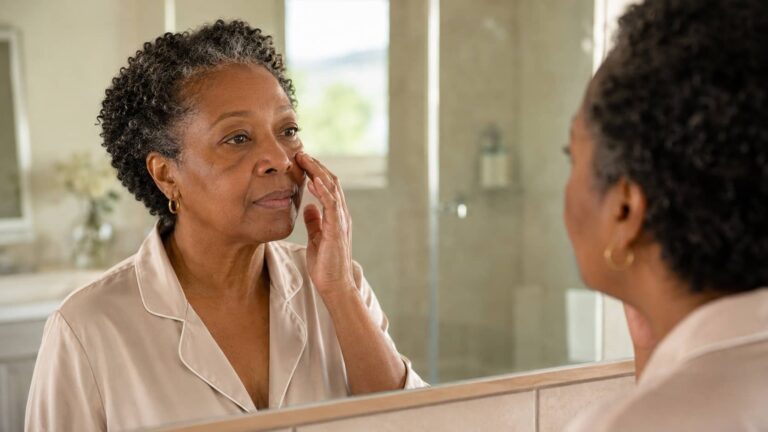

Menopause facial hair can feel as though it appeared overnight. One coarse hair on your chin becomes three. You start checking your jawline in the mirror more closely. Perhaps you find yourself keeping tweezers in your handbag for hairs you swear were not there the day before.
For many women, facial hair becomes more noticeable during perimenopause and after menopause. The chin, jawline and upper lip are particularly common places to see the change.
And if you have melanin rich skin, there can be another concern beyond the hair itself. Repeated plucking, shaving, waxing or digging at an ingrown hair can leave inflammation behind and that inflammation can turn into a dark mark that lasts much longer than the hair you were trying to remove.
Understanding what is happening hormonally, and choosing a removal method that respects mature Black skin, can make managing these changes much easier. Facial hair is only one of the changes menopause can bring after 50, alongside shifts in skin, scalp hair, sleep, mood and how your body feels.
Why Menopause Facial Hair Starts Growing After 50
To understand facial hair after menopause, it helps to look at what is happening with estrogen and androgens.
Women naturally produce both estrogen and androgens, including testosterone. Around menopause, ovarian estrogen production falls substantially. Androgen production changes too, but the decline does not necessarily happen at exactly the same rate. Levels of sex hormone binding globulin can also decrease, which can affect the amount of biologically available androgen.
The result can be a relative shift toward androgen influence, even if your testosterone level itself is not unusually high. This changing hormonal balance can make facial hair more noticeable, particularly around the chin and jawline.
It can feel particularly contradictory when facial hair becomes more noticeable at the same time that the hair along your scalp or edges begins to thin. If that is happening too, read our guide to thinning hair and edges after 50.
This is an important distinction.
If you search for low estrogen facial hair, it is easy to come away believing that low estrogen simply switches on testosterone and causes a beard to grow. The biology is more nuanced. The balance between hormones changes, and some hair follicles are particularly sensitive to that changing balance.
The follicles around the chin, upper lip and jawline can respond by producing more noticeable terminal hairs the darker, thicker hairs that feel very different from fine facial “peach fuzz.”
Facial hair changes after menopause are not unusual. One population study found that facial hair gain was reported by a substantial proportion of postmenopausal women, with the chin the most frequently reported site, although that study population was not representative of all ethnic groups.
Genetics, previous hormonal conditions and your individual sensitivity to androgens also influence how much change you see.
And no, noticing several chin hairs does not automatically mean something is medically wrong.
Does Menopause Facial Hair Ever Go Away?
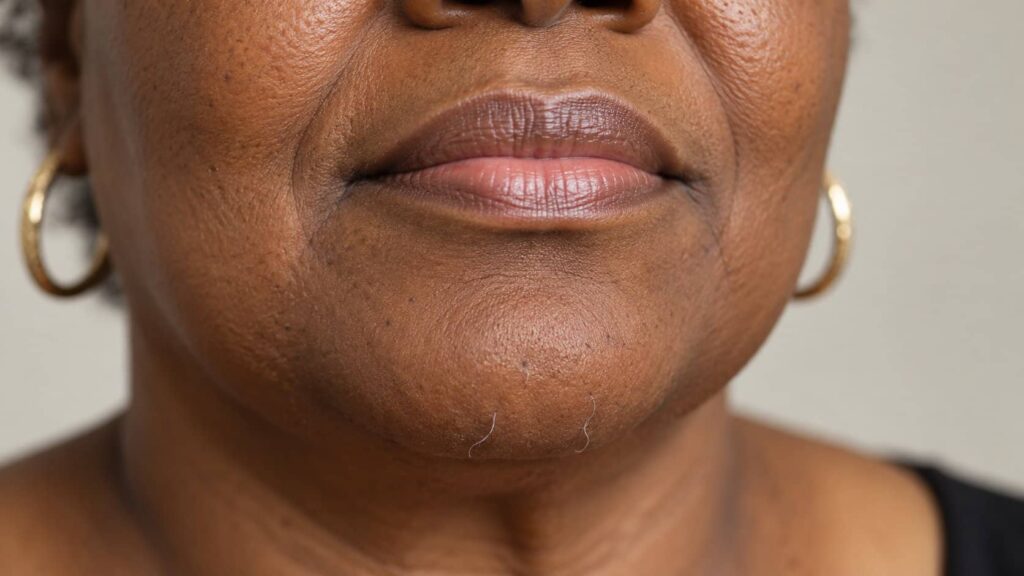
This is one of the most understandable questions women ask: does menopause facial hair ever go away?
Usually, once a follicle has started producing a coarse terminal hair, you should not expect that hair simply to disappear once menopause is “over.”
Menopause is not a temporary hormonal phase after which estrogen returns to its previous premenopausal level. It marks a lasting biological transition.
That does not mean your facial hair will necessarily continue becoming heavier year after year. For some women, the change remains relatively minor: a few coarse chin hairs or slightly more visible hair along the jaw. For others, the growth becomes more persistent.
The outlook also depends on what is causing the hair growth. Hirsutism associated with hormonal sensitivity can persist, and physical or medical treatments may be needed if a woman wants to reduce it.
What you do not need to do is panic because three chin hairs have appeared.
They may simply be another small sign that the hormonal landscape has changed.
Why Chin Hair Can Become Coarser After Menopause
There is a reason chin hair after menopause gets so much attention.
Hair follicles in certain areas of the body are more responsive to androgens. The chin, jawline and upper lip are among them.
Under greater androgen influence, a follicle that previously produced a soft, fine hair may begin producing a thicker and more pigmented terminal hair.
That is why a woman may suddenly notice one hair that feels surprisingly wiry or coarse compared with the fine hairs surrounding it.
The phrase coarse chin hair female may sound clinical when typed into a search box, but the experience is very ordinary: you run your fingers over your chin and feel one stubborn hair before you can even see it.
The hormonal shift after menopause can help explain why it appears, but it is not the only possible influence. Family tendency, previous polycystic ovary syndrome, certain medications and other endocrine conditions can also affect facial hair growth. Hirsutism can have several causes, and in some women no single cause is identified.
One useful thing to remember is that shaving does not make the hair follicle produce thicker hair. Shaving cuts the hair at the skin’s surface. Because the cut tip is blunt, the hair may feel coarser as it grows back, but shaving has not changed the follicle itself.
That old beauty warning has caused women unnecessary anxiety for years.
Menopause Facial Hair Removal: What Works on Melanin Rich Skin
There is no single best menopause facial hair removal method for every Black woman over 50.
The right choice depends on how much hair you have, whether it is fine or coarse, how sensitive your skin is and whether you are already dealing with razor bumps or hyperpigmentation.
Mature skin deserves a little more restraint. Menopause can be accompanied by increasing dryness and changes in skin thickness and barrier function, so repeatedly attacking the same area with aggressive hair removal can create another problem while solving the first. The American Academy of Dermatology specifically cautions that menopausal skin may become too delicate for some waxing practices.
Tweezing
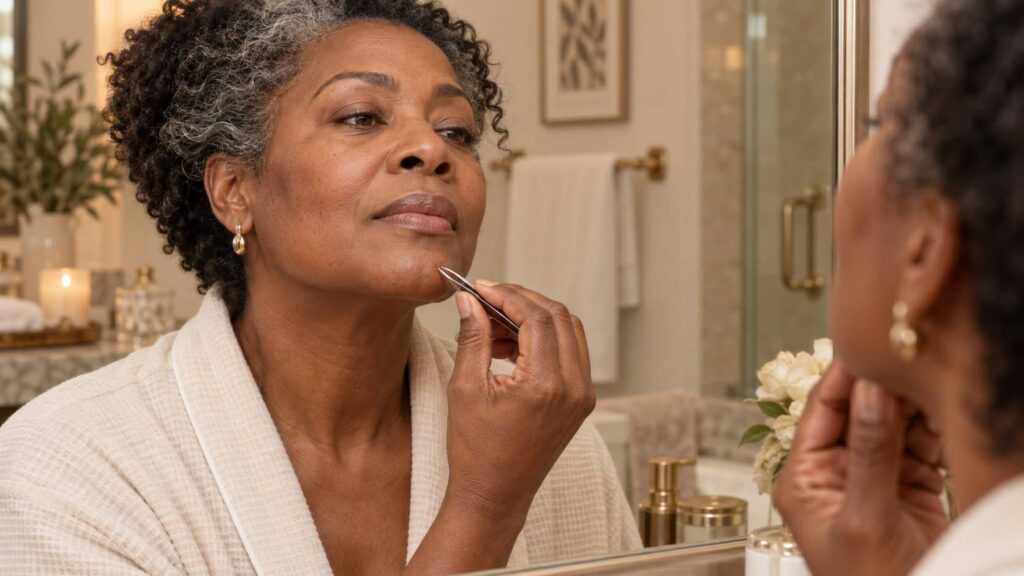
For two or three isolated chin hairs, tweezing is simple and practical.
Use clean tweezers and remove the hair in the direction of growth rather than repeatedly digging into the skin trying to catch a hair that has not properly emerged.
The danger is not the tweezer itself. It is the cycle of squeezing, scratching and repeatedly disturbing the same follicle.
On melanin rich skin, that inflammation can leave a mark long after the follicle has settled.
Shaving
Shaving is a perfectly legitimate facial-hair removal method for women.
If you choose it, soften the skin and hair first, use a shaving cream or gel, avoid repeatedly passing over the same area and shave in the direction of hair growth where possible. Dermatologists recommend these practices to reduce irritation, razor burn and ingrown hairs.
If your hair is tightly curled, shaving extremely close to the skin may increase the chance that the growing hair curves back into the skin.
For some women, an electric facial trimmer that leaves an extremely short amount of hair rather than cutting directly beneath the skin surface is more comfortable.
Waxing
Waxing removes hair from the root, which means the result lasts longer than shaving.
But mature skin requires caution.
Waxing can cause temporary redness and irritation, and hot wax can burn the skin. The American Academy of Dermatology advises against waxing skin treated with tretinoin and recommends avoiding facial waxing for several days after using retinol or prescription retinoids because the skin may be more vulnerable to injury.
If you already have irritated, peeling or sensitised skin, this is not the moment to wax it.
Depilatory creams
Facial depilatory creams chemically dissolve the hair.
They are convenient, but they can also cause irritant dermatitis. Patch testing matters, particularly if you have sensitive skin or a history of post-inflammatory hyperpigmentation.
A product being labelled for facial use does not guarantee that your particular skin will tolerate it.
Electrolysis
Electrolysis treats individual hair follicles using electrical energy.
It can offer permanent hair removal, but treatment is slow because follicles are treated individually and several sessions may be required. Poorly performed electrolysis can also result in scarring or pigment changes.
This makes practitioner experience especially important for melanin-rich skin.
Electrolysis also has one advantage when the unwanted hairs are grey, white or very light: unlike laser treatment, it does not depend on pigment in the hair to identify its target.
That becomes increasingly relevant after 50.
Laser hair removal
Laser can significantly reduce dark, coarse facial hair, but Black skin deserves specialist expertise.
Laser technology works partly by targeting melanin. Because darker skin also contains more epidermal melanin, poorly selected technology or inappropriate settings can increase the risk of burns and unwanted pigment changes.
Long-pulsed Nd 1064 nm technology is widely regarded as the safest laser approach for hair removal in skin of colour because its wavelength reduces absorption by epidermal melanin compared with some shorterwavelength devices.
That does not mean every clinic offering an Nd laser is automatically the right clinic.
Ask how often the practitioner treats Fitzpatrick V and VI skin, what device is being used, what cooling system is employed and whether a test area is appropriate before committing to a course.
Your skin should never be the practitioner’s experiment.
How to Avoid Chin Bumps and Dark Marks After Hair Removal
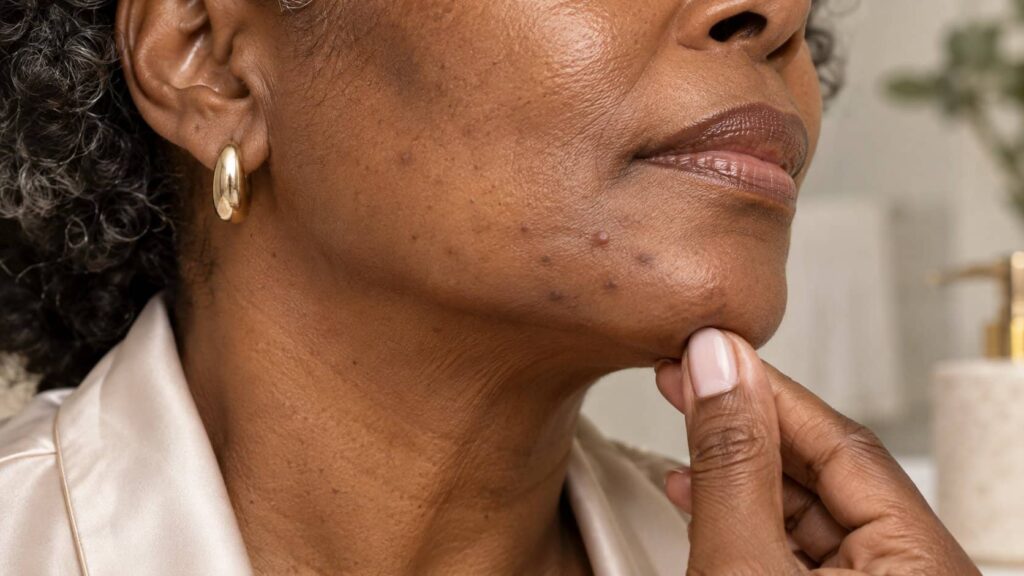
For Black women, removing the hair can be the easy part.
Preventing what happens afterward may require more care.
A coarse or tightly curled hair can curve back toward the skin after shaving or plucking. When it re-enters or grows beneath the surface, the body responds as though something foreign has entered the skin.
The result can be a tender bump, inflammation or what is medically called pseudofolliculitis barbae.
Although it is often discussed in relation to men’s beard areas, women who shave or remove coarse facial hair can experience it too. It is more common in people with tightly curled, coarse hair, and persistent cases can leave both hyperpigmentation and scarring.
This matters enormously for melanin rich skin.
Inflammation can look different on Black skin, and it can also leave a visible pigment response behind. Darker skin is particularly susceptible to post inflammatory hyperpigmentation, meaning the dark mark left behind can remain for weeks or months after the original bump has healed. Research on skin of colour consistently identifies inflammation and skin injury as important triggers for PIH.
So if you are searching for how to get rid of chin hair bumps, start by looking at how the hair is being removed.
A very close shave followed by repeated picking at emerging hairs is likely to keep the inflammation cycle going.
Keep removal tools clean. Use plenty of slip if shaving. Work with the direction of growth rather than repeatedly scraping against it. Resist the temptation to dig under the skin with tweezers.
Then give the area time to calm down.
Gentle skincare matters more here than an aggressive dark spot attack. If your skin is calm enough for exfoliation, our guide to gentle exfoliation for mature skin explains how to do it without overworking the skin.
Ingredients such as azelaic acid, niacinamide, salicylic acid or carefully chosen retinoids may have a place in a routine depending on your skin and the type of bumps or pigmentation you have, but more exfoliation is not always better.
If your chin already burns, flakes or feels sore, restoring comfort comes before adding another active.
And daily sun protection still matters. UV and visible light exposure can make existing pigmentation harder to fade.
When New Facial Hair After Menopause Should Be Checked by a Doctor

A few slowly developing chin hairs after menopause are very different from sudden, extensive facial hair growth.
Rapid progression deserves medical attention.
Doctors become more concerned when coarse hair develops quickly over a period of months or appears alongside other signs of significant androgen excess.
Those signs can include a noticeably deeper voice, new severe acne, rapid scalp hair loss, increased muscularity or other signs of virilisation. Postmenopausal endocrine reviews specifically recommend further investigation when hirsutism develops rapidly or occurs with virilising features because, although uncommon, ovarian or adrenal disorders can sometimes be responsible.
Certain medicines and supplements can also contribute to excess hair growth, so mention everything you take including over the counter hormonal or bodybuilding supplements when speaking with your doctor.
This section is not here to make ordinary chin hair frightening.
It is here because women deserve to know the difference between a common menopausal change and something that deserves a closer look.
If your facial hair has increased gradually and you otherwise feel well, there is rarely a reason to assume the worst.
But if the change feels dramatic, rapid or accompanied by other unusual symptoms, speak to your doctor, dermatologist or endocrinologist rather than trying to solve it entirely at the bathroom mirror.
Facial Hair After Menopause Is Not Something to Be Ashamed Of
Menopause has a strange sense of humour.
Hair may become thinner where you spent decades wanting it thick, while a determined chin hair appears in a place where you never invited it.
But there is nothing unfeminine or shameful about this change.
And there is no rule saying you must remove facial hair at all.
If you want to leave it alone, that is a perfectly valid choice. If you prefer a completely smooth chin, that is valid too.
The goal is not to “fix” a normal woman whose hormones have changed.
The goal is to understand what your skin and hair are doing now, so that whatever choice you make does not create a second problem.
For Black women over 50, that means thinking beyond the question, How quickly can I remove this hair?
The better question may be:
How can I remove it while keeping my skin calm?
Because when melanin-rich skin is prone to holding onto the memory of inflammation, the gentlest effective method often proves more valuable than the most aggressive one.
The Bottom Line
Menopause facial hair can become more noticeable as estrogen declines and the hormonal balance shifts toward greater relative androgen influence. Coarse hairs may appear on the chin, jawline or upper lip, and established terminal hairs do not usually disappear simply because menopause has passed.
There are several ways to manage them, including tweezing, shaving, waxing, electrolysis and laser hair reduction.
For melanin-rich skin, however, hair removal should never be considered separately from inflammation.
Razor bumps, ingrown hairs and repeated picking can trigger post-inflammatory hyperpigmentation that lasts far longer than the hair itself.
Choose the method your skin tolerates, be especially careful with aggressive removal techniques, and seek experienced professional treatment when considering laser or electrolysis.
And if facial-hair growth becomes sudden, extensive or accompanied by other signs of androgen excess, have it medically evaluated.
Your body is changing.
Understanding those changes without shame and without panic is part of learning how to care for it now.