Can Menopause Cause Hyperpigmentation? This warm, honest guide explains why dark spots and melasma often get worse after 50, how hormonal changes affect melanin rich skin, and what helps Black women over 50 care for hyperpigmentation more effectively.
The honest answer, the real science, and what helps melanin rich skin after 50
After 22 years working with Black skin, I lost count of how many women sat in my chair and asked the same question. Why are my dark spots suddenly worse.
Sometimes they thought it was a bad product. Sometimes they thought they had stopped trying hard enough. Sometimes they blamed the sunscreen they skipped on holiday ten years ago. But again and again, the answer was sitting deeper than the skincare shelf. It was hormonal.
If this sounds familiar, I want you to hear me clearly. You are not imagining it. And you are not failing your skin.
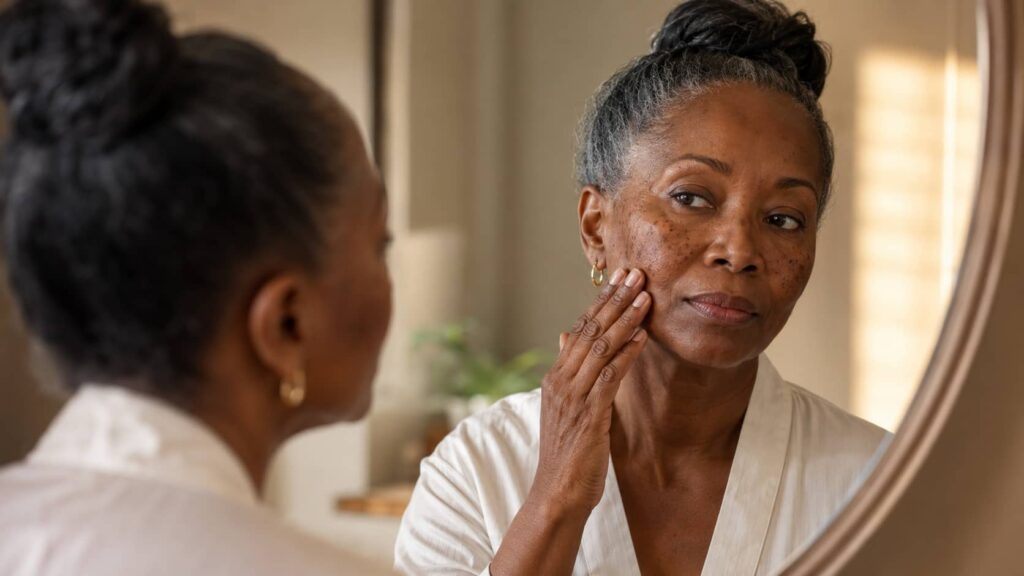
For years, your skin may have behaved in a way you understood. You knew which marks would fade. You knew what your routine could handle. You knew what to expect when you looked in the mirror. Then somewhere in your late forties or fifties, the rules seemed to change. Old spots got darker. New patches showed up. Melasma started to appear on the cheeks, forehead, or upper lip. And the products that used to be enough suddenly were not enough anymore.
That change is real. And once you understand what is happening, the next step gets a lot less frustrating.
Can menopause cause hyperpigmentation
Yes. Menopause can worsen hyperpigmentation, especially melasma, and it can make dark spots look more stubborn after 50. Changing estrogen levels during perimenopause and menopause can influence pigmentation. At the same time, menopausal skin often becomes drier, more sensitive, and slower to renew. That combination can make discoloration more noticeable and harder to fade.
That means if your pigmentation changed around the same time your body changed, there is a real reason for it. This is not random. It is not vanity. And it is not you doing something wrong.
What menopause is doing to your skin
Let me keep this simple.
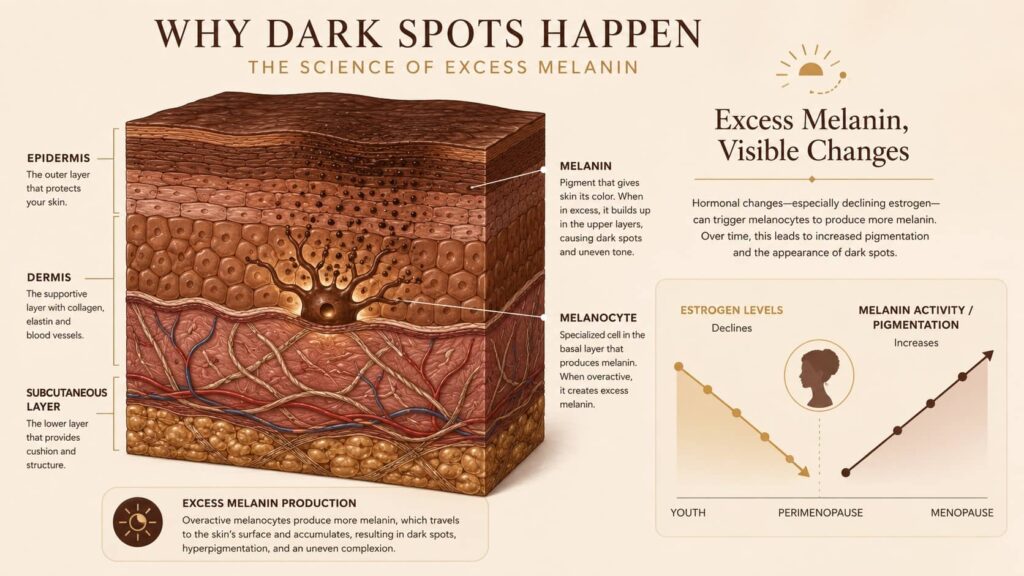
Estrogen has been doing quiet work for your skin for years. It helps support hydration, smoothness, and resilience. As estrogen changes during perimenopause and menopause, skin often becomes drier and itchier, and skin turnover slows down. That is one reason menopause can make your skin feel thinner, duller, and more reactive than it used to.
Now add pigment to that picture.
The British Skin Foundation explains that changing estrogen levels can disrupt the balance that regulates melanin production and distribution, potentially triggering or worsening melasma. Melasma itself is a common condition that causes brown or grayish brown patches, usually on the face, and it is more common in women and in people of colour.
So when you say, my dark spots got worse after 50, the answer is often not only age. It is age plus hormones plus slower renewal plus years of sun and visible light exposure finally showing up more clearly.
From the salon chair
Women used to tell me they felt betrayed by their own skin. They had finally gotten their dark spots under control, and then everything changed. I always told them the same thing. Your skin is not betraying you. It is responding to a real shift. Once you understand the shift, you stop fighting blindly and start caring for it properly.
Melasma, dark spots, and post inflammatory hyperpigmentation are not the same thing
This part matters, because many women use all three terms as if they mean the same thing.
Melasma usually shows up as larger patches of discoloration, often on the cheeks, forehead, upper lip, or chin. It has a strong link with hormones and is more common in medium to dark skin tones. Post inflammatory hyperpigmentation, often called PIH, is different. PIH happens after inflammation or irritation. A breakout, friction, harsh treatment, or skin injury leaves a mark behind. The Skin of Color Society says PIH is very common in darker skin, and more than 65 percent of African Americans experience it.
Then there are the dark spots people notice from years of sun exposure and slower cell turnover. Those may not be melasma and may not be PIH, but menopause can still make them look worse because your skin is renewing more slowly and reacting more easily.
Why Black skin often feels this harder after 50
This is where broad beauty advice usually stops being useful.
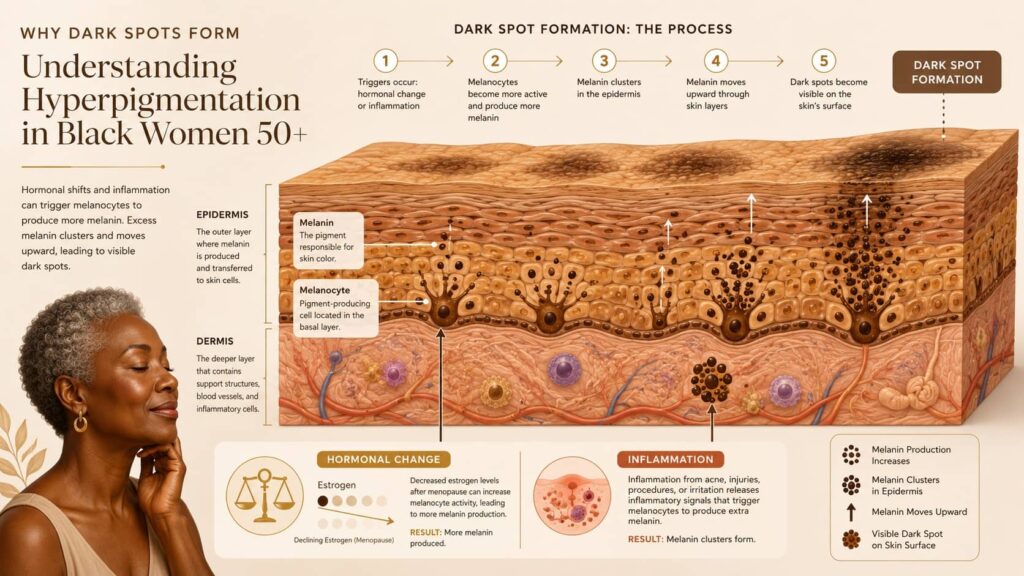
Melanin rich skin has strengths. It also has patterns. One of those patterns is that when our skin gets irritated, it is more likely to respond with lingering pigment. The Skin of Color Society notes that PIH is very common in darker skin, precisely because inflammation and irritation are more likely to leave discoloration behind.
Now think about what menopause does. It often brings dryness, sensitivity, and itch. Dry, sensitive skin gets irritated more easily. Irritated skin is more likely to leave pigment behind. So even if menopause is not creating every mark by itself, it is creating the kind of skin environment where marks are more likely to appear, deepen, and stay longer.
This is also why harsh treatment plans can backfire. If a product or procedure inflames your skin too much, the skin can answer back with more discoloration. That is why Black skin needs care that is thoughtful, steady, and specific. Not aggressive for the sake of looking serious.
What actually helps
This is the part you have been waiting for. And I am going to answer it the same way I always answered women in the salon. Gently, but honestly.
First, sunscreen comes first. Not eventually. Not when you remember. Every day.
The American Academy of Dermatology says effective treatment for dark spots begins with sunscreen. For darker skin tones and pigment prone skin, the AAD specifically recommends tinted sunscreen with iron oxide, because visible light can worsen dark spots. The Skin of Color Society also recommends choosing products with iron oxides to help protect against visible light.
That means a broad spectrum sunscreen is your baseline, but for melasma and stubborn hyperpigmentation, a tinted sunscreen with iron oxide is often the better daily choice.
Second, choose ingredients that fade pigment without pushing your skin into more irritation.
The AAD notes that dermatologists may use ingredients such as azelaic acid, hydroquinone, retinoids, kojic acid, and vitamin C, depending on the person and the diagnosis. That does not mean you need all of them. It means there are real options, and the right plan depends on your skin, your level of sensitivity, and whether you are dealing with melasma, PIH, or both.
For many women over 50, a gentler starting point makes sense. Azelaic acid, niacinamide, vitamin C, and tranexamic acid often fit beautifully into a calm routine, especially when the skin barrier is feeling fragile. Prescription options may help too, but I would not self treat strong pigment conditions without good guidance if your skin is already reactive.
Third, protect the barrier.
Menopausal skin is often drier and more sensitive. That is not a side note. That is part of the whole story. When your barrier is weak, inflammation rises more easily. When inflammation rises, pigment tends to hang around longer. Richer moisturisers, gentle cleansing, and less over exfoliation make a real difference here.
Fourth, slow down.
I know the urge. You see pigment, you want to attack it. Still, mature melanin rarely responds well to panic. Product hopping, harsh acids, too many actives, and too much exfoliation can leave you with a more irritated face and darker marks.
Steady wins here. Quiet, boring consistency wins here.
When to see a dermatologist
If the pigmentation is spreading, getting darker fast, or looking like true melasma, it is worth seeing a dermatologist. The AAD says a dermatologist can tell you whether you have melasma or another condition and can guide treatment from there. That matters because not every patch of discoloration should be treated the same way.
This matters even more if you are considering professional treatments. Peels, lasers, and other procedures can help in the right hands, but the wrong treatment on the wrong skin can make things worse. If you book an appointment, ask directly about experience with Black skin. Ask what their plan is to protect against post inflammatory hyperpigmentation. Ask what aftercare looks like.
Those are not difficult questions. They are necessary ones.
A practical routine for this stage of life
If I were speaking to you like an old friend, this is what I would say.
Start simple.
Use a gentle cleanser.
Use a moisturiser that supports the barrier.
Use a tinted sunscreen with iron oxide every morning.
Pick one pigment fighting ingredient, not four.
Give it time.
Photograph your skin in the same light every few weeks instead of checking it emotionally every morning.
That kind of routine is not flashy. It is effective.
And if you already know your skin is easily irritated, treat that as valuable information, not a flaw. Sensitive skin is not weak skin. It is skin that asks for a different style of care.
From the salon chair
Our skin does not need to be bullied into behaving. It needs to be understood. Especially after 50. Especially when hormones are changing the rules.
You are not failing. Your skin is changing.
If I want you to take one thing from this piece, it is this.
The hyperpigmentation you are seeing is not proof that you have failed your skin. It is proof that your skin is moving through a real transition with you.
Your hormones changed.
Your barrier changed.
Your renewal rate changed.
Your pigment got harder to manage.
That is the truth.
The good news is that dark spots and melasma can improve with the right care, even after menopause. It usually takes patience. It usually takes more gentleness than most women expect. But it is possible.
So no, I do not want you blaming yourself.
I want you protecting your skin.
I want you choosing your products more wisely.
I want you giving your skin the kind of care that respects where it is now, not where it was ten years ago.
That is what The Melanin Tone is here for.