

What Black women over 50 should know about exosome microneedling, skin and scalp treatments, pigmentation risk and the questions to ask before saying yes.
Exosome treatment is attracting growing attention for skin rejuvenation and hair concerns, but the science, products and professional procedures being marketed under that name are not all the same.
That distinction matters.
You may see exosomes offered after microneedling. You may see treatments promoted for ageing skin, pigmentation or thinning hair. You may even hear language suggesting that this is the next great step in regenerative beauty.
Promising? Yes.
Settled science? Not yet.
And after spending 22 years working with women in beauty, there is one lesson I still believe in strongly: what happens before a treatment can be just as important as the treatment itself.
The consultation is where you discover whether the person sitting opposite you understands your skin, your hair and the treatment they are asking you to pay for.
This final chapter of The Melanin Tone Exosome Series is therefore not here to persuade you to have an exosome treatment.
It is here to make sure that if you consider one, you know what to ask before you agree.
What Is Exosome Treatment?
Exosomes are tiny extracellular vesicles released by cells. They carry molecules involved in communication between cells, which is one reason researchers are studying their potential role in areas including tissue repair, inflammation, skin ageing and hair biology.
If you want to begin with the science, What Is Exosome Therapy? Why Black Women 50+ Should Be Paying Attention explains the basics in Part 1 of this series.
Professional exosome treatment is a broader and less standardised category than the name might suggest.
One clinic may apply an exosome-containing product after microneedling.
Another may use a different source, formulation or delivery technique.
Products may also differ considerably in how they are manufactured, processed, characterised and regulated.
That is why simply being told, “We use exosomes,” is not enough information.
You need to know what the product actually is.
Exosomes for Skin – Why Is There So Much Interest?
The interest in exosomes for skin comes largely from their role in cell-to-cell signalling.
Researchers are investigating whether exosome-containing preparations may influence processes involved in skin repair, hydration, pigmentation, collagen-related changes and inflammation.
There are encouraging early clinical findings.
For example, a small randomised split-face study involving 28 participants compared microneedling alone with microneedling plus a human adipose stem-cell-derived exosome-containing solution. The exosome-treated side showed greater improvement in several measured features of facial ageing, including wrinkles, elasticity, hydration and pigmentation.
But one small study does not establish how every commercial exosome product will perform.
Different sources.
Different formulations.
Different concentrations.
Different delivery methods.
Different patients.
That is why I would be very cautious when a clinic takes promising early research and turns it into a guaranteed result.
What Is Exosome Microneedling?
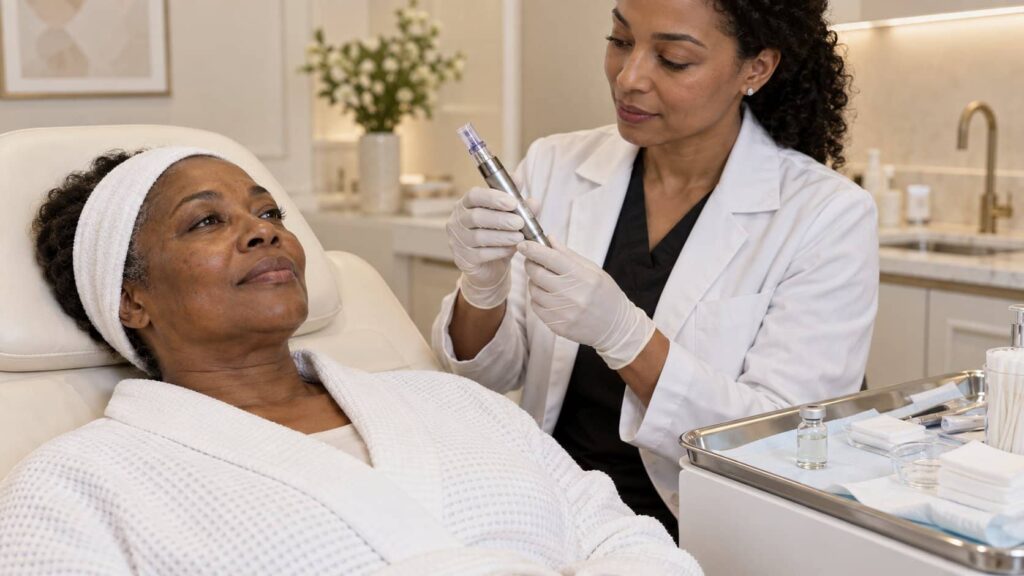
Exosome microneedling combines a microneedling procedure with an exosome-containing or exosome-based topical product.
Microneedling creates controlled microscopic injuries in the skin using fine needles. The procedure itself has long been studied for concerns such as scarring, texture and skin rejuvenation.
With exosome microneedling, a product containing or marketed as containing exosomes is generally applied in connection with the procedure.
The idea is that the two approaches may complement each other.
But this is exactly where marketing language can get ahead of evidence.
A 2026 systematic review examining microneedling combined with exosomes found only eight studies suitable for its final analysis. Individual study sizes ranged from just 3 to 60 participants. The reviewers described the results as promising but concluded that more evidence is needed before the safety and efficacy of the combination can be firmly established.
That is important context.
Exosome microneedling is promising. Promising is not the same as proven.
Exosome Microneedling Benefits – What Does the Evidence Actually Show?
You may see clinics advertise exosome microneedling benefits such as smoother skin, improved hydration, better texture, reduced pigmentation, firmer-looking skin or improved recovery after microneedling.
Some early studies do report improvements in these areas.
The problem is not that there is no research.
The problem is that the evidence base is still relatively small and the products and protocols vary.
That makes it difficult to say that one particular commercial exosome treatment will reproduce the results of another study.
The 2026 systematic review included research relating to skin ageing, pigmentation, scarring, enlarged pores and androgenetic alopecia. The authors still concluded that larger and better-quality studies are needed.
So when you see an impressive list of benefits on a clinic website, ask a simple question:
Which of those benefits has been demonstrated with the exact product and protocol you intend to use on me?
That is a much harder question to answer with marketing language alone.
Exosomes in Dermatology – What Is Established and What Is Still Emerging?
Exosomes in dermatology are an active area of research.
That does not mean every treatment currently being sold has gone through the same level of clinical testing or regulatory scrutiny.
This is particularly important when we move beyond a cosmetic serum sitting on the surface of the skin and into treatments involving microneedling or other procedures that disrupt the skin barrier.
In the United States, the FDA states that there are currently no FDA-approved exosome products. It has also warned about unapproved exosome products following reports of serious adverse events.
If you live outside the United States, your regulatory system will be different.
That does not make the question less important.
Ask your dermatologist or provider:
What is the regulatory status of this exact product where I live?
And ask them to explain the answer.
“Everybody uses it” is not a regulatory status.
Is Exosome Microneedling Safe for Black Skin?
This is one of the most important questions in this entire article.
Microneedling itself is not automatically unsuitable for Black skin.
A review specifically examining microneedling in skin of colour found that the procedure has been used for several dermatological concerns and may offer advantages for darker skin compared with some more aggressive resurfacing techniques.
But that does not mean every procedure is risk-free.
For melanin rich skin, inflammation matters because post-inflammatory hyperpigmentation occurs more frequently and can be more persistent in darker skin tones.
That is why I would want the dermatologist to assess more than my skin colour.
What is my history of hyperpigmentation?
Do I develop dark marks easily after inflammation?
Do I have active acne, eczema or another inflammatory condition?
What products am I using?
Have I recently had another procedure?
What needle depth and technique are appropriate for the concern being treated?
And what is the plan if pigmentation develops afterwards?
The correct protocol should be individualised.
I would be suspicious of anyone who tells you that every Black patient requires exactly the same settings simply because she has dark skin.
Can Exosome Treatment Help Melasma and Hyperpigmentation?
Research into exosomes for melasma and other forms of pigmentation is interesting, but this is an area where I would resist hype particularly strongly.
A small 2024 case series followed 12 women who received microneedling with a rose stem-cell-derived extracellular-vesicle product for facial pigmentation. Improvements were reported, but the study was small and was designed as proof-of-concept research.
There are also ongoing clinical studies examining exosome-based approaches to melasma, which tells us something important in itself.
The question is still being investigated.
If you already struggle with hyperpigmentation, particularly pigmentation that develops after inflammation, I would want an experienced dermatologist involved before experimenting with a new procedure.
The fact that a treatment is advertised for pigmentation does not mean it cannot also provoke inflammation.
Is Microneedling With Exosomes Worth It?
This is where the answer becomes personal.
Is microneedling with exosomes worth it?
Perhaps.
But I would not answer that question until I knew:
What concern are we treating?
What evidence supports using exosomes for that particular concern?
What exact product is being used?
Would microneedling alone be a reasonable option?
Are there more established treatments available?
What are the risks for my skin?
How many sessions are being recommended?
And what will the entire course cost?
If the dermatologist cannot explain what the exosome portion adds beyond microneedling itself, that would matter to me.
Remember, the question is not whether exosomes sound advanced.
The question is whether this treatment makes sense for you.
What to Ask Your Dermatologist Before You Agree to Exosome Treatment

This is the section I would save on your phone before your consultation.
What exact exosome product are you using?
Ask for the product name and manufacturer.
Ask what the exosomes or extracellular vesicles are derived from.
Ask whether the product used in the clinic is the same one used in the research the provider is quoting.
If they cannot clearly identify what they are putting onto or into your skin, I would not proceed.
What is the regulatory status of this product?
Ask whether it is approved, authorised or otherwise permitted for the proposed use where you live.
If the provider starts talking around the question rather than answering it, pay attention.
How will the product be delivered?
Will it be applied after microneedling?
Is another device being used?
Is anything being injected?
The method matters.
Do not allow different procedures to be grouped together simply because the word “exosomes” appears in all of them.
What evidence supports this treatment for my concern?
Not exosomes generally.
Your concern.
If you are treating skin ageing, ask for evidence relating to skin ageing.
If you are concerned about pigmentation, ask about pigmentation.
If the issue is hair loss, ask about your diagnosed type of hair loss.
What experience do you have treating melanin rich skin?
I would want more than “we treat all skin types.”
Ask about patients with skin similar to yours.
Ask what complications they have seen.
Ask how they approach a patient who has a history of post-inflammatory hyperpigmentation.
A good clinician should be comfortable discussing complications, not only before-and-after photographs.
What are the risks for my skin?
Every procedure has a risk profile.
Ask about irritation, infection, prolonged inflammation, pigmentation changes and any product-specific concerns.
And ask what happens if something goes wrong.
What results can I realistically expect?
Be careful with promises.
One treatment cannot guarantee that your skin will look ten years younger.
No responsible provider can guarantee hair regrowth.
Ask what change would be considered realistic and how long you should wait before judging the result.
How many sessions are you recommending and why?
Do not buy a package simply because it is presented as standard.
Ask why that number of sessions has been recommended for you.
Then ask what happens if you see no meaningful improvement.
What should I stop before treatment?
Retinoids, exfoliating acids, prescription products and other treatments may need individual consideration.
Do not create your own preparation routine from social media.
Ask the person carrying out the procedure.
What does aftercare look like?
You should leave the consultation knowing how to cleanse, moisturise and protect your skin afterwards.
You should also know when you can restart active ingredients and which symptoms warrant contacting the clinic.
For melanin-rich skin, I would specifically ask about pigmentation prevention and sun protection.
Considering Exosome Hair Treatment? Ask This First
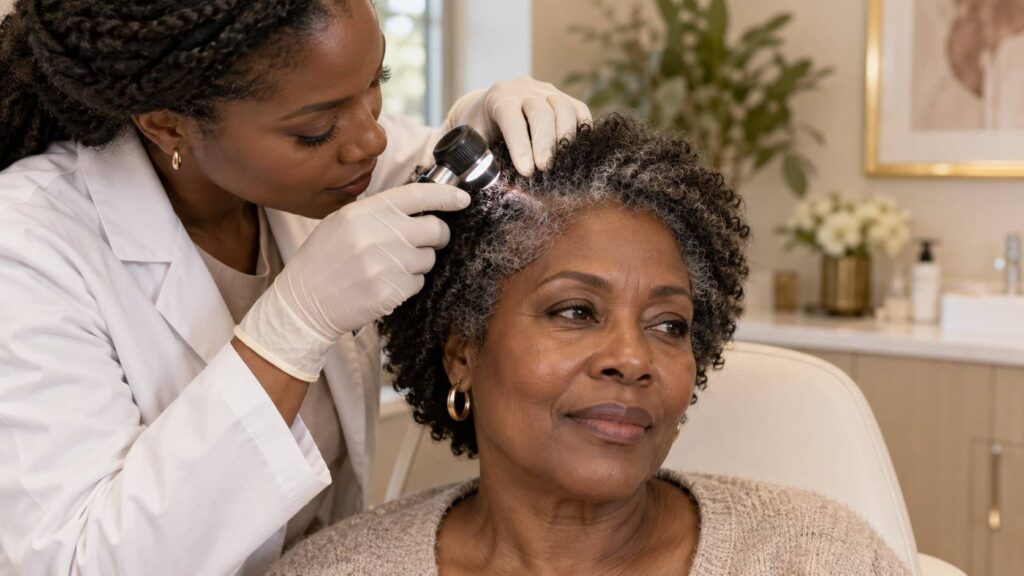
There is one question I would put before every other question about exosome hair treatment:
What is causing my hair loss?
Do not start with exosomes.
Start with the diagnosis.
Female-pattern hair loss, traction alopecia, central centrifugal cicatricial alopecia and other hair-loss conditions are not the same problem.
An exosome procedure should never delay an appropriate medical assessment, particularly if you have ongoing shedding, inflammation, scalp symptoms or progressive thinning.
If hair is your main concern, How Long Does Exosome Hair Therapy Last? The Complete FAQ goes much deeper into the hair side of this series.
And if your concern is specifically a fragile hairline or thinning edges, I would investigate the cause before assuming that an expensive regenerative treatment is the answer.
Green Flags and Red Flags When Choosing a Provider
You should leave a good consultation feeling informed rather than rushed.
Green flags: the provider names the exact product, explains what is known and what remains uncertain, asks about your medical and skin history, discusses alternatives, understands pigmentation concerns in darker skin, gives realistic expectations, explains aftercare and gives you time to make a decision.
Red flags: they cannot tell you what product they use, describe exosomes as guaranteed regenerative medicine, promise dramatic results, dismiss questions about pigmentation or regulation, cannot explain their complication plan, or pressure you to purchase a multi-session package immediately.
An expensive treatment room can still contain poor advice.
A beautiful clinic does not replace evidence.
The Melanin Tone Exosome Series: The Complete Guide
We have reached the final chapter.
If you arrived here first, you can follow the full series from the beginning.
Part 1
What Is Exosome Therapy? Why Black Women 50+ Should Be Paying Attention
Start with the science. What exosomes are, why they have become such a major beauty conversation and what mature melanin-rich skin should know.
Part 2
How Long Does Exosome Hair Therapy Last? The Complete FAQ
The hair chapter. What the evidence suggests, what we still do not know and the questions to ask about professional hair treatment.
Part 3
The Exosome Edit – Luxury Serums & Scalp Treatments for Melanin 50+
The at-home edit. A closer look at the serums and scalp treatments being sold under the exosome banner.
Part 4
Dr. Barbara Sturm vs. The INKEY List – Splurge or Save?
Two very different price points and one important question: does spending considerably more necessarily give you more?
Part 5
Exosome Treatment: What to Ask Your Dermatologist Before You Agree to Treatment
The professional-treatment chapter. What to ask, what to question and why an informed consultation matters.
Five posts.
One subject examined from five different angles.
Not an advertisement for exosomes.
An education about them.
The Honest Takeaway
I am interested in exosomes.
The science is fascinating.
The early clinical research gives us good reason to keep watching this field.
But fascination should never prevent us from asking difficult questions.
New does not automatically mean better. Expensive does not automatically mean effective. And promising does not mean proven.
Before agreeing to exosome treatment, ask what the product is.
Ask where it came from.
Ask what evidence supports it.
Ask what the risks are for your skin.
Ask whether there is a more established alternative.
And ask what happens if you decide not to proceed.
After 22 years in beauty, I still believe knowledge changes the balance of a treatment-room conversation.
You do not need to know everything your dermatologist knows.
But you should understand enough to recognise when your questions are not being answered.
For Black women over 50, that kind of confidence matters.
That is what The Melanin Tone is here for.