
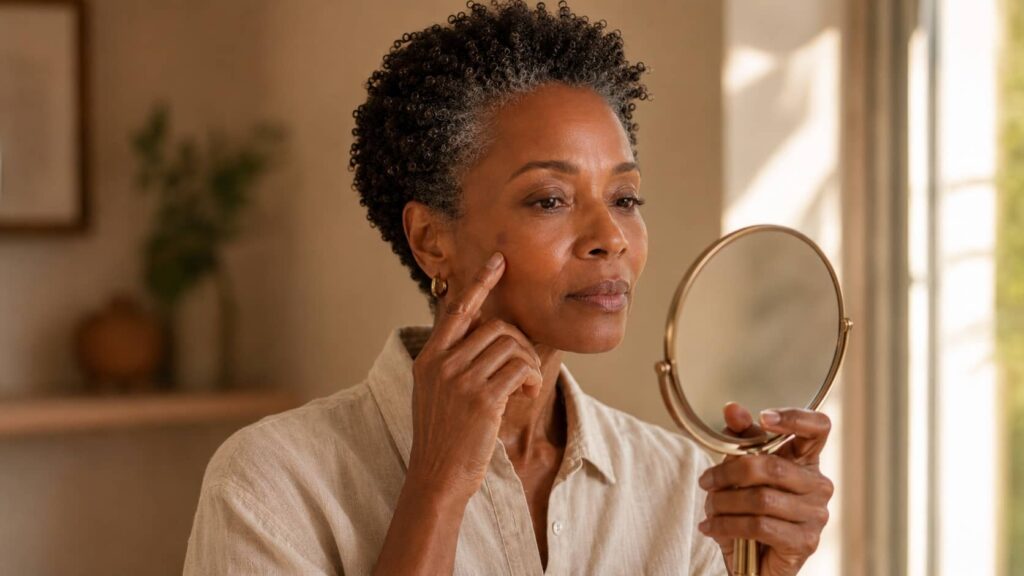
You scratched a mosquito bite at twenty four, and the dark mark it left behind faded in three weeks. You broke out on your forehead at thirty two, and the mark faded in two months. You got a small scrape on your cheek at forty one, and it faded in four months. Back then, dark spots on Black skin came and went on a schedule you could count on.
Now you are fifty three. A small blemish healed three months ago. The dark spot is still there. You can see it in every selfie. You can see it under your foundation. You have tried the brightening serum your sister recommended, the vitamin C you saw on Instagram, the dark spot corrector from the drugstore, and nothing has touched it. You are starting to wonder whether dark spots on Black skin after 50 are just permanent now, or whether you are doing something wrong.
You are not doing something wrong. Dark spots on Black skin take longer to fade after 50, and the reasons have very little to do with what is in your bathroom cabinet. They have everything to do with what is happening underneath your skin. This is the conversation about hyperpigmentation black skin and aging that almost nobody is having clearly for women in their fifties.
I spent 22 years behind a salon chair watching Black women’s skin change across the decades. I watched the dark mark from one breakout fade in weeks for the same client whose dark mark from a similar breakout twenty years later took half a year. Same skin. Same person. Different timeline. The skin had not failed her. Her skin had simply moved into a new chapter that nobody had explained.
Let me explain it now.
What Is Actually Happening to Dark Spots on Mature Black Skin
When you get a blemish, a bug bite, a scrape, a patch of irritation, or any other small injury on your skin, your body responds by sending pigment producing cells to the area. Those cells, called melanocytes, deposit extra melanin into the surrounding skin as part of the healing process. The dark mark you see is that extra melanin sitting in the skin while the area finishes recovering. Dermatologists call this post inflammatory hyperpigmentation, and on Black skin it shows up more deeply, more reliably, and more stubbornly than on lighter skin.
In younger skin, the body clears that extra pigment quickly. Cell turnover is fast. Old skin cells, including the pigmented ones, are shed and replaced with new ones in roughly twenty eight days. A dark spot in young skin is a temporary visitor that the body politely escorts out within a few cell turnover cycles.
In mature Black skin, three things change at the same time, and all three slow the fading process down.
Cell turnover slows. By your fifties, the twenty eight day cycle has stretched closer to forty or fifty days. The pigmented cells stay in your skin twice as long simply because your body is replacing them at half the speed.
Pigment cells become more reactive. The melanocytes that produce extra pigment in response to injury become more sensitive in midlife. Smaller triggers create darker spots. A breakout that would have left a faint mark at thirty leaves a deeper mark at fifty three.
The skin barrier becomes more sensitive. The barrier that holds your skin together and protects it from irritants becomes thinner and more reactive after the estrogen drop of perimenopause. Every small irritation, every aggressive product, every sun exposure, every friction point becomes a trigger for new pigment deposition. The skin you are trying to fade is also more likely to develop new spots while you wait.
Put together, what you are looking at in the mirror is not a single dark spot that refuses to fade. You are looking at a slower clearing system, a more reactive pigment response, and a barrier that is fragile enough to make the whole process worse if you treat it aggressively.
That last point is the one most women miss, and it is the most important.
Hyperpigmentation Black Skin – Why It Becomes Harder to Fade After 50
Hyperpigmentation black skin becomes harder to fade after 50 for three connected reasons that overlap on the same face at the same time. The biological reason, the hormonal reason, and the behavioral reason.
The biological reason is what I just explained. Slower cell turnover, more reactive melanocytes, and a more sensitive barrier. None of this is preventable. It is the same biology that happens to every human face after fifty, only on Black skin it shows aging primarily as hyperpigmentation rather than as fine lines.
The hormonal reason is menopause. The estrogen drop of perimenopause and menopause makes pigmentation problems worse in two ways. It triggers melasma, which is the patchy hyperpigmentation that often shows up for the first time in a woman’s forties or early fifties along the cheeks, the upper lip, the forehead, and the jawline. It also makes existing dark spots more stubborn, because hormonal pigmentation responds to far smaller triggers than non hormonal pigmentation. UV exposure, heat, friction from a face mask, and stress all worsen melasma in ways that did not affect your skin in earlier decades.
The behavioral reason is the one that is genuinely fixable. Many Black women over 50 are still using the same approach to dark spots they used at thirty. Aggressive exfoliants. Strong scrubs. High concentration actives layered all at once. Skipping sunscreen because melanin was supposed to protect. Picking at blemishes. Using products that strip the barrier and trigger more pigment in the process.
Mature Black skin needs the opposite approach. Gentle, patient, layered, and protected. Most of the women I worked with were not failing at fading their dark spots. They were attacking them. The skin pushed back.
The shift in midlife is from active treatment to active protection. Less stripping, more shielding. Less aggressive, more consistent. The dark spots fade when the skin is allowed to do its slow work without new damage being added on top.
Dark Spots on Black Skin Face: Where They Show Up Most
Dark spots on black skin face follow predictable patterns at this stage of life, and recognizing the patterns helps you understand what kind of pigmentation you are dealing with.
The most common pattern is post inflammatory hyperpigmentation, which is the dark marks left behind by old breakouts, ingrown hairs, irritation, friction, or any other minor inflammation. These spots tend to match the location of the original injury. They are usually round or oval. They fade over months to years depending on age, skin care, and sun exposure.
The second pattern is melasma. Melasma appears as larger, irregular patches rather than spots, and it shows up on specific facial zones. The upper lip. The cheeks just below the eyes. The forehead. The jawline. Melasma is often symmetrical, meaning it appears on both sides of the face at once. It flares with hormones, heat, and sun. It softens with patience but rarely disappears completely.
The third pattern is sun damage. Years of unprotected UV exposure show up as deeper, darker patches that often appear on the higher zones of the face, the cheekbones, the bridge of the nose, the forehead. Sun damage hyperpigmentation is the most stubborn of the three because the underlying cause keeps adding to it every day until daily sunscreen breaks the cycle.
Most Black women over 50 have a mix of all three. A few post inflammatory dark spots from old breakouts. A melasma patch flaring with menopause. Sun damage built up over decades of skipped sunscreen. Each pattern responds slightly differently to treatment, which is why a one size fits all approach to fading hyperpigmentation rarely works on mature Black skin.
How to get rid of dark spots on black skin starts with knowing what kind of dark spots you are dealing with. From there, the treatment becomes a real plan instead of a hopeful guess.
The Ingredients That Actually Fade Dark Spots on Black Skin
Before you reach for any active ingredient, the first rule of fading dark spots on mature Black skin is to stop triggering new ones. Until you address the triggers, no serum on earth will fix the problem because the rate of new pigment production will outpace the rate of fading.
Here are the triggers that most often sabotage Black women over 50 who are trying to fade dark spots.
Unprotected sun exposure. Every minute of UV on a face with active hyperpigmentation deepens the marks and triggers new ones. Daily sunscreen with SPF 30 or higher is not optional. Iron oxide containing tinted sunscreens are the best choice because they also block visible light, which worsens pigmentation in deeper skin tones.
Aggressive exfoliation. Physical scrubs, brushes, and harsh acids strip the barrier and trigger inflammatory pigmentation. Replace any rough scrub with a gentle chemical exfoliant like lactic acid or mandelic acid, used no more than two or three times a week.
Heat. Hot showers, saunas, steam, and even hot environments can worsen melasma. Cooler water on the face, limited steam exposure, and avoiding direct heat help reduce flares.
Friction. Face masks, glasses sliding down the nose, scrubbing with towels, and even rubbing the face during cleansing can trigger pigmentation in mature melanated skin. Pat dry. Touch less. Treat the skin like it is fragile.
Picking. The single most common cause of new dark spots is picking at existing blemishes. Every time you pick, you create new inflammation, and that inflammation will leave a darker mark than the original blemish would have. Let the blemish heal untouched.
Once these triggers are reduced, the actual fading work can begin. Several ingredients have real research behind them for fading hyperpigmentation on Black skin specifically. These are the ones worth knowing.
Niacinamide is the gentlest and most reliable. Used at five percent or lower, it reduces the transfer of pigment to skin cells, calms inflammation, and supports the barrier. It rarely irritates. It is the best starting ingredient for mature melanated skin with hyperpigmentation.
Vitamin C, particularly L ascorbic acid, brightens the complexion and supports the cellular processes that fade pigment over time. Use at ten to fifteen percent in the morning, on dry skin, before sunscreen. Buy small bottles and replace them when they turn orange, because vitamin C oxidizes and loses effectiveness.
Azelaic acid is one of the most underrated ingredients for Black skin with dark spots. It fades pigmentation, calms inflammation, and treats acne at the same time. Used at ten percent in the evening, it is gentle enough for mature skin and effective enough to make a visible difference over three to six months.
Tranexamic acid is newer to the mainstream skincare conversation but has been used by dermatologists for melasma for years. Available in topical serums at two to five percent, it specifically targets the pigment production pathway and can fade stubborn melasma when other ingredients fail.
Encapsulated retinol works on dark spots indirectly by speeding up cell turnover and helping the pigmented cells move out of the skin faster. Start at the lowest concentration, two nights a week, with a moisturizer over the top. Build slowly. Wear sunscreen every morning without exception, because retinol use without daily sunscreen will trigger new dark spots faster than it fades old ones.
What is not on this list is also worth naming. Hydroquinone, the long standing prescription brightener, is effective but carries risks for Black skin, including a paradoxical darkening called ochronosis with long term use. Use it only under dermatologist supervision and only for short cycles. Skip the bleaching creams marketed in some Black communities. The active ingredients in many of them are unregulated and can cause permanent damage to mature melanated skin.

A Realistic Routine for Fading Dark Spots Over 50
Here is the routine I would build for a Black woman over 50 who is trying to fade dark spots without making them worse. This is the practical answer to dark spots on black skin treatment.
Morning:
Gentle cream cleanser. Vitamin C serum at ten percent on dry skin. Niacinamide serum or a moisturizer that contains niacinamide. Moisturizer with ceramides. Tinted sunscreen with iron oxides at SPF 30 or higher.
Evening, three nights per week:
Gentle cream cleanser. Azelaic acid at ten percent on clean dry skin. Moisturizer with peptides and ceramides.
Evening, two nights per week:
Gentle cream cleanser. Encapsulated retinol at the lowest concentration. Moisturizer applied over the top to buffer.
Evening, two nights per week:
Gentle cream cleanser. Hydrating serum with hyaluronic acid. Rich moisturizer. Rest night, no actives.
That is the routine. Five active ingredients. Used in rotation. Layered carefully. Protected with sunscreen every morning. This is not the most exciting routine, but it is the one that fades dark spots on mature Black skin without triggering new ones.
Expect three to six months before you see meaningful change. Some melasma takes a full year. Spots from older breakouts can fade in two to four months if the triggers are controlled. Spots from years of unprotected sun exposure are slower. Patience is part of the protocol.
If after six months of consistent routine and consistent sunscreen you see no improvement, see a dermatologist who knows Black skin. They can offer prescription options like tretinoin, prescription strength azelaic acid, or low concentration hydroquinone under medical supervision. They can also confirm whether what you are dealing with is post inflammatory hyperpigmentation, melasma, or a combination of both, which affects which treatment will work.
The Honest Truth About Dark Spots and Patience
One last thing, because every post on this site ends with the truth.
There is no serum that will get rid of dark spots on black skin in two weeks. There is no overnight miracle. There is no acid strong enough, no brightener concentrated enough, no peel intense enough to safely undo years of pigment in a single bottle. Every product that promises to do this on mature Black skin is either lying or about to damage your barrier in a way that will create more dark spots than it fades.
The truth is that fading hyperpigmentation on Black skin after 50 is a long, slow, patient process. The work is in the consistency, not the intensity. The women whose skin looks evenly toned at sixty are not the women who attacked their skin with every new active. They are the women who chose three or four ingredients, used them every day for a year, wore sunscreen every morning without exception, and let the skin do its slow work in the background while they got on with their lives.
The dark spot on your cheek that has been there for three months will eventually fade. The dark mark on your jaw from the breakout last fall will eventually go. The melasma along your upper lip can soften with time and care. None of it will fade in the time frame you wish for. All of it will fade if you stop fighting your skin and start supporting it.
The skin you have at fifty three has carried you through five decades. It is asking you for gentleness and patience, not aggression. Give it both, and it will give you back the even tone you have been chasing.
The mirror is not lying about how slow the fading is. The mirror is telling you what your skin has always told you. The body keeps its own time. You can wait.