
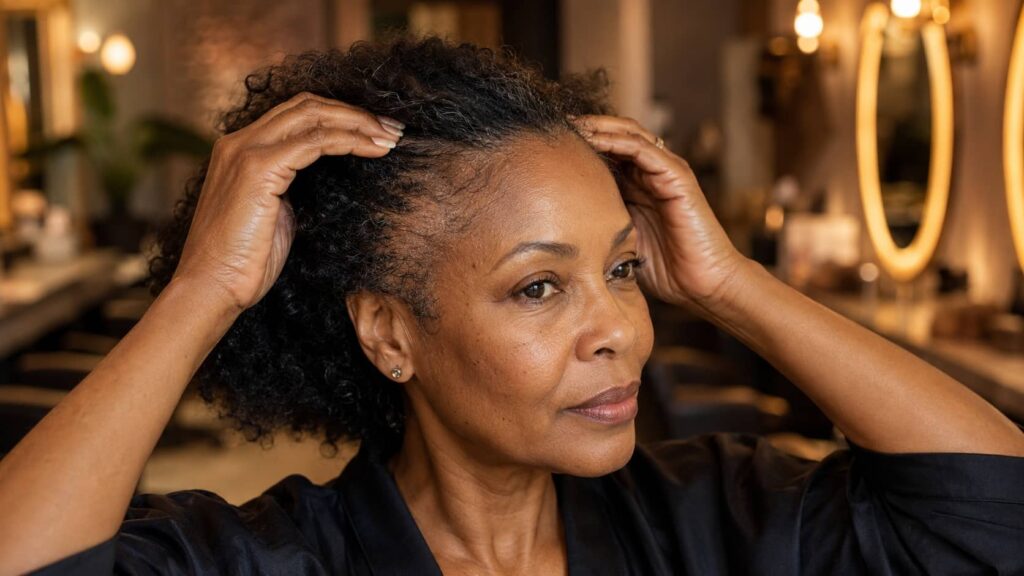
Thinning edges can come from more than one cause, and the right answer depends on the right diagnosis. This article explains what thinning edges can mean for Black women over 50, how to tell traction alopecia from other forms of hair loss, when regrowth is still possible, and which warning signs mean it is time to see a dermatologist.
From the salon chair, how to spot traction alopecia, menopause hair thinning, and when regrowth is still possible
After 22 years in a salon, I have seen more thinning edges than I can count. I have seen the quiet panic. I have seen the hats pulled lower. I have seen women touch their temples before they sit down, as if they are apologising for something they did not choose.
So let me start with the truth.
Not all thinning edges are the same. Not all of them will grow back. And not all of them should be treated with another oil, another serum, or another internet promise.
Before we talk about products, we need to talk about cause.
That is the part the beauty industry often skips. It is easier to sell hope than it is to explain diagnosis. Still, the right diagnosis shapes everything. The cause matters. The timing matters. And the earlier you act, the better your chances of protecting the follicles you still have.
What are you really seeing when you say my edges are thinning
When most Black women talk about thinning edges, they mean one of a few things. The hairline looks less full. The temples look wider. The front feels fragile. The tiny hairs around the perimeter are gone. The style still looks neat, but the hairline underneath looks tired.
That feeling is real. And you are not imagining it.
Sometimes the issue is true edge thinning. Sometimes the issue is thinning across the top of the scalp that makes the front look weaker too. Sometimes it is breakage. Sometimes it is traction. Sometimes it is a medical condition. Sometimes it is a natural hairline that has always been sparse. “About an 8 minute read.”
That is why one answer does not fit every woman.
The first truth, diagnosis comes first
If your thinning edges come from repeated pulling, the plan is one thing.
If they come from menopause related thinning, the plan is another.
If they come from a scarring condition, the plan is different again.
And if the follicle has already scarred, no beautifully packaged promise is going to reverse it.
That is not negativity. That is honesty.
The most common reasons edges thin
Traction alopecia
This is one of the biggest reasons edges thin in Black women. It happens when the hair is pulled in the same way for too long. Tight braids, tight ponytails, tight buns, tight loc styles, extensions, weaves, and styles that hurt on day one all belong in this conversation.
At first, the signs may look small. Broken hairs around the forehead. A hairline that looks a little less full. Tenderness after styling. Tiny bumps. A feeling of tightness that you try to ignore.
Over time, that repeated pulling can damage the follicle enough that the hair stops coming back.
Menopause hair thinning
Menopause can bring hair thinning, reduced volume, and changes in texture. Hair may feel finer, drier, weaker, or more brittle. The whole scalp can look less dense. The temples can seem less full. The hairline can start looking softer.
Still, menopause does not always create a classic traction pattern on its own. It can make the hairline look weaker, but when the front is clearly receding or breaking, there may be more than hormones going on.
Female pattern hair loss
This type of thinning often starts around the part. The part widens. The top looks thinner. The ponytail feels smaller. The front hairline often stays fairly normal, which is why some women think their edges are thinning when the bigger issue is general density loss on the top of the scalp.
Frontal fibrosing alopecia
This one matters for women over 50. It often appears as a slow recession along the front and sides of the hairline. Some women also notice eyebrow loss. Others feel itch, pain, or sensitivity.
This is important because it can be a form of permanent hair loss. That means early diagnosis matters. Waiting and hoping is not the best strategy here.
Alopecia areata
This is an autoimmune condition. It often appears as sudden smooth patches of hair loss, but it can affect other areas too. If your thinning showed up quickly or in distinct bare patches, this belongs on the list.
CCCA
CCCA usually starts in the center of the scalp, not at the edges. Still, I want Black women over 50 to know this name. It can come with itching, burning, tenderness, stinging, or a scaly, bumpy scalp. It needs medical attention. The earlier it is treated, the better the chance of protecting the hair you still have.
Natural Hairline
Sometimes the hairline is simply the hairline. Some women have naturally sparse temples or a naturally high perimeter. That is not damage. That is not disease. That is not something that needs fixing unless it has clearly changed.
From the salon chair
One of the kindest things I learned in 22 years was this. Not every hair concern needs a miracle. Some need treatment. Some need patience. Some need acceptance. Wisdom is knowing which is which.
Can thinning edges grow back
Sometimes, yes.
Sometimes, no.
That answer depends on whether the follicle is still alive, what caused the loss, and how quickly you address it.
If the thinning is recent and the follicle is still healthy enough, regrowth may be possible.
If the thinning comes from repeated tension and you stop early enough, the hairline may improve.
If hormones are part of the picture, treating the broader issue may help.
If the cause is a scarring condition, early treatment may help protect what is still there and sometimes recover a little.
If the follicle is gone, the hair will not come back.
This is the part many women need to hear clearly. Not every edge can be restored. That is why wasting time on promises can cost you more than money. It can cost you the chance to act early.
The phrase I want you to stop believing
How to grow edges in 2 weeks.
No. You cannot regrow thinning edges in two weeks.
Hair moves slowly. Damaged follicles move even slower. And scarring follicles do not follow social media timelines.
What you can do in two weeks is stop the damage, calm the scalp, and start a plan that gives your hair the best chance of recovery. That matters. Still, it is not the same as visible regrowth.
What actually helps, if regrowth is still possible
First, stop the cause
If the loss is from tension, remove the tension. Not reduce it a little. Remove it. If a style hurts, gives you a headache, leaves bumps, or pulls your temples shiny, it is too tight.
This means giving your hairline a real break. No tight braids. No tight ponytails. No heavy extensions. No styles that keep pulling the same fragile area.
Second, treat the scalp like it matters
Healthy hair needs a healthy scalp. Keep the area clean. Keep irritation low. Avoid harsh scrubbing. Avoid layering random products in the hope that one of them will save you.
If you are dealing with itch, pain, burning, scaling, or tenderness, treat those symptoms as clues, not small inconveniences.
Third, get the diagnosis before you build the routine
This is where many women lose time. They buy oils. They buy edge control with growth claims. They buy another serum, another supplement, another bonnet. Meanwhile, the real cause remains untreated.
If the problem is female pattern hair loss, the treatment plan may look one way.
If the problem is CCCA, you may need prescription care.
If the problem is frontal fibrosing alopecia, the goal is often to slow progression and protect the hair you still have.
The routine should follow the diagnosis, not the other way around.
Fourth, take menopause seriously, but do not blame every edge on menopause
Hormonal change can thin the hair and make everything look less full. Menopause belongs in the story. It is not always the whole story.
If the pattern is mainly at the hairline, especially with itch, pain, eyebrow loss, or shiny skin, do not assume it is only hormones.
Fifth, give time a fair chance
Real hair work takes months, not days. Take a clear photo now. Take another in twelve weeks. Then compare. Hair progress is easier to trust when you can see it, not only feel it.
Red flags, when to see a dermatologist fast
Please do not sit on these signs.
A painful or itchy hairline.
A shiny band of bare skin along the front or sides.
Eyebrow loss with a receding hairline.
Burning, stinging, tenderness, bumps, crusting, or scale on the scalp.
Hair loss that starts at the crown and spreads outward.
Sudden smooth patches of hair loss.
Those signs tell me this is no longer a wait and see situation.
The shame piece
I cannot write this without saying the quiet part out loud.
Women feel shame around thinning edges.
I saw it in the salon for years.
The lowered voice. The hand over the temple. The wig placed carefully so nobody sees the hairline underneath. The fear that this means something is wrong with you, or that you did this to yourself, or that you waited too long.
Hairline loss hits hard because it sits at the front of the story. You see it first. Other people see it first. And for Black women, hair has never been only hair. It carries identity, memory, beauty, history, and presentation. So when the edges thin, the grief is real.
Please hear me clearly. Caring about your edges does not make you vain. It makes you human.
And if they do not fully come back, that does not reduce your beauty, your dignity, or your presence.

My honest closing
Your edges have a story. Before you reach for a promise, learn the story.
If the loss is recent and the follicle is still healthy enough, you may be able to protect it and see regrowth. If the cause is scarring and you catch it early, treatment may still help preserve what you have and sometimes recover a little. If the follicle is gone, then the next chapter is not false hope. It is wise care, smart styling, and honest acceptance.
That is the tone I want for The Melanin Tone. No false promises. No panic. No shame. Just real answers, so you can make your next move with clarity.