
Why some products stop serving your skin after menopause, and what to choose instead
Bad skincare products after 50 are not always obviously bad. Some are products you may have used happily for years. The problem is that your skin can change around menopause while your routine stays exactly the same.
During my 22 years in beauty, I saw this often. Women would keep buying the same cleanser, the same scrub, or the same heavy moisturising product and then wonder why their face suddenly felt tighter, duller, itchier, or more reactive.
They thought their skin had become difficult.
Sometimes the routine had simply stopped matching the skin they had now.
For Black women over 50, irritation can bring another concern. On melanin rich skin, inflammation can leave dark spots and hyperpigmentation long after the original irritation has settled.
So this is not a list telling you that three ingredients are universally bad.
It is about three product types worth rethinking when your skin becomes drier, more sensitive, or easier to irritate after 50.
And, more importantly, what you can use instead.
Why Mature Skin Needs Different Products After 50
Mature skin does not suddenly become one universal skin type when you turn 50. You can still have oily, dry, combination, sensitive, or acne prone skin.
But changes around menopause can affect what your skin tolerates.
As oestrogen levels fall, skin can become drier and thinner and may lose some of its firmness. It can also lose water more easily, which is one reason products that once felt perfectly comfortable may begin to feel too harsh.
That does not mean your skin is weak.
It means its needs may have changed.
A cleanser that once made you feel wonderfully clean may now leave your face tight.
A scrub that once gave you instant smoothness may now leave you irritated.
A very heavy balm may feel comforting but still not give dehydrated skin everything it needs.
The answer is not necessarily more skincare.
Very often, it is better chosen skincare.
Bad Skincare Product One: Harsh, Stripping Cleansers
The first product I would rethink is a cleanser that leaves your face feeling squeaky, tight, dry, or uncomfortable.
Notice that I did not say every foaming cleanser is bad.
Foam itself is not the enemy.
The problem is a formula that removes more oil than your skin comfortably tolerates.
Why It May Be Time to Rethink It
Cleansing should remove makeup, sunscreen, excess oil, and everyday buildup.
It should not leave your face feeling as though every drop of moisture has been washed away.
As skin becomes drier with age, repeatedly stripping it can contribute to tightness, flaking, irritation, and discomfort.
And once the barrier is irritated, the active products you apply afterwards may sting more than they normally would.
Why This Matters for Melanin Rich Skin
Inflammation can be followed by post inflammatory hyperpigmentation, particularly in darker skin tones.
So the irritation caused by an overly harsh routine may disappear while the resulting dark mark stays around much longer.
That is why I care less about whether a cleanser produces luxurious foam and more about what your skin feels like after you rinse it away.
What to Use Instead
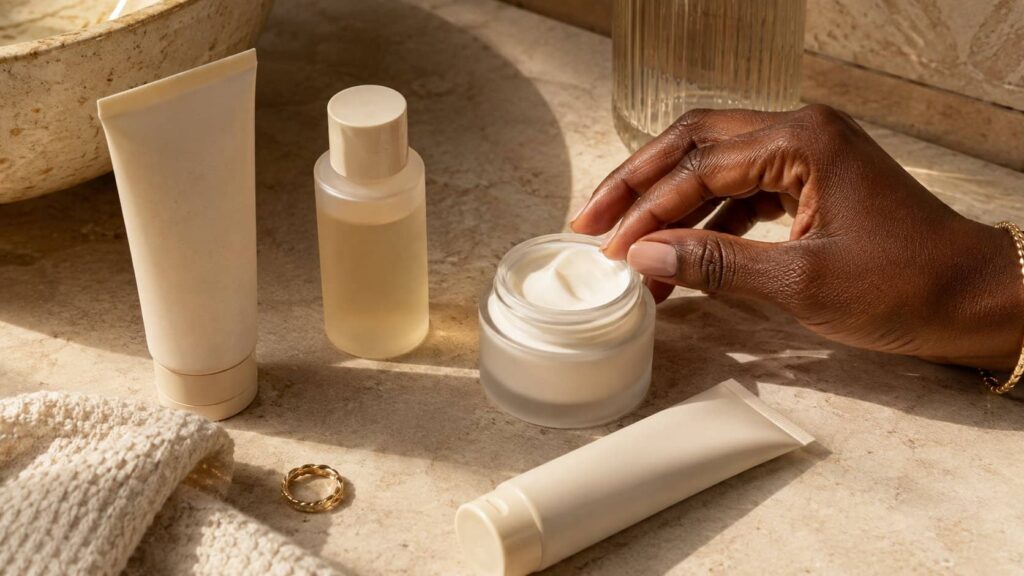
Look for a gentle cream cleanser, cleansing milk, or hydrating cleanser that removes daily buildup without leaving your face tight.
Ingredients such as glycerin, ceramides, or squalane can be useful in a well formulated cleanser, but you do not need all three.
Your skin should feel clean.
It should also feel comfortable.
That is the test.
Bad Skincare Product Two: Coarse Physical Scrubs
The second product I would rethink is the rough facial scrub.
You know the type. Gritty particles, crushed shells, seeds, or other coarse ingredients that promise to polish dull skin away.
I understand the attraction.
When skin looks dull, scrubbing gives instant feedback. You can feel something happening.
But feeling more does not always mean achieving more.
Why It May Be Time to Rethink It
Aggressive scrubbing can irritate the skin, particularly when it is done frequently or with too much pressure.
And mature skin does not need additional irritation simply because it looks dull.
Sometimes what looks like dullness is partly dryness or dehydration.
Scrubbing harder will not correct that.
Why This Matters for Black Skin
Inflammation and skin injury can trigger increased pigment production. When the inflammation settles, a darker patch may remain.
This is known as post inflammatory hyperpigmentation.
So if you are scrubbing aggressively because you are trying to fade an uneven complexion, you can end up creating the very problem you were trying to solve.
What to Use Instead
If your skin still benefits from gentle exfoliation, consider a milder approach.
A PHA, such as gluconolactone, or a low strength lactic acid product may be easier for some mature skin types to tolerate than an aggressive scrub.
But exfoliation is not compulsory.
Some women do well once a week. Some need it far less often. Some may not need regular exfoliation at all.
Start gently and watch your skin.
The goal is smoother skin.
Not sore skin.
Bad Skincare Product Three: Heavy Oils or Petrolatum as Your Only Moisturizer
This is the one I want to explain carefully because I do not want you throwing away a perfectly useful jar of petrolatum after reading this.
Petrolatum is not a bad skincare ingredient.
Neither are facial oils automatically bad.
Petrolatum can be very useful for dry skin because it helps reduce water loss.
The problem is relying on a heavy oil or occlusive as your entire moisturising routine when your skin needs hydration as well.
Why It May Be Time to Rethink How You Use It
An occlusive works mainly by helping to seal moisture into the skin.
That can be extremely useful.
But if your skin is already dehydrated, simply putting an oily layer over the top may not address everything your skin needs.
Think of it this way.
You need something worth sealing in.
A well formulated moisturizer may combine water binding ingredients, emollients, and barrier supportive ingredients in one product. If extra occlusion helps your particularly dry areas, you can then use petrolatum strategically on top.
What About Breakouts?
Some women continue to experience breakouts in midlife.
If a very heavy product consistently seems to leave your individual skin congested or uncomfortable, you do not have to keep using it simply because somebody said mature skin needs something rich.
Your skin decides whether a product suits you.
And for melanin rich skin, preventing unnecessary inflammation matters because a breakout can leave a dark mark long after the spot itself has gone.
What to Use Instead
Start with a moisturizer that actually addresses dryness and dehydration.
Look for useful moisturizing ingredients such as glycerin, ceramides, hyaluronic acid, fatty acids, or other barrier supporting ingredients depending on the formula.
You do not need a cream advertising a magical ratio.
You need a moisturizer your skin tolerates, that makes it feel comfortable, and that you will use consistently.
If petrolatum helps very dry areas, you can still use it.
Just think of it as a useful sealing step rather than assuming it has to be your entire skincare routine.
The Common Skincare Mistakes to Stop Making After 50
Products are only part of the problem.
Sometimes it is the way we use them.
Over the years, I saw the same skincare mistakes repeated again and again:
- Believing tight, squeaky skin means your cleanser worked better.
- Scrubbing harder because your complexion looks dull.
- Introducing several strong active ingredients at the same time.
- Assuming a product has to sting before it can work.
- Skipping sunscreen because melanin gives some natural sun protection.
- Using a heavy oil on dehydrated skin without addressing hydration.
- Buying more products instead of asking whether the products already on the shelf are irritating your skin.
There is value in learning about toxic ingredients and ingredients that may irritate sensitive or pigmentation prone skin. But the ingredient list is only one part of the picture.
The complete formula matters.
How often you use it matters.
What you combine it with matters.
And most importantly, how your own skin responds matters.
What to Use Instead: A Simple Routine for Mature Black Skin
If we are removing the stripping, scratching, and overdoing, what takes their place?
Something much simpler.
In the morning, cleanse gently if your skin needs it, follow with a moisturizer that suits your level of dryness, and finish with broad spectrum sunscreen.
At night, cleanse away sunscreen, makeup, and daily buildup, then moisturize.
After that, add treatment products only where there is a reason to use them.
If dullness is genuinely a concern and your skin tolerates gentle exfoliation, introduce it gradually.
If pigmentation is the concern, choose a targeted treatment rather than throwing several brightening actives onto your face at once.
If dryness is the concern, focus first on hydration and barrier support.
Your routine does not have to impress anybody.
It simply has to work for your skin.
From the Salon Chair
One of the beauty beliefs I spent years trying to unteach was the idea that discomfort meant effectiveness.
If the cleanser squeaked, it must have cleaned properly.
If the scrub felt rough, it must have removed more dead skin.
If a treatment stung, it must have been doing something powerful.
I never believed mature skin needed to be punished into behaving.
When women moved towards gentler care, many told me their skin felt more comfortable and less irritated. That mattered to me far more than convincing them to add another bottle to the shelf.
There is nothing weak about gentle skincare.
Sometimes knowing what not to do is one of the most useful things you can learn about your skin.

Frequently Asked Questions
What are bad skincare products after 50?
There is no universal list of products that become bad on your 50th birthday. The products worth rethinking are the ones that repeatedly leave your skin stripped, irritated, congested, or uncomfortable. Harsh cleansers, aggressive scrubs, and relying only on heavy occlusives are three common examples.
Are foaming cleansers bad for mature skin?
Not necessarily. Some foaming cleansers are gentle and well formulated. What matters is how your skin feels afterwards. If a cleanser repeatedly leaves mature skin tight, dry, itchy, or uncomfortable, it may be too stripping for you.
What is the best cleanser for mature skin?
The best cleanser for mature skin is one that removes daily buildup without leaving the face stripped. Many women prefer a cream cleanser, cleansing milk, or gentle hydrating cleanser as their skin becomes drier.
Should you exfoliate mature skin?
You can, but you do not have to. If exfoliation helps with surface dullness or texture, start gently and use a product your skin tolerates. Mature skin does not automatically need exfoliation several times a week.
Is petrolatum bad for mature skin?
No. Petrolatum is an effective occlusive and can be very useful for dry skin. The issue is treating it as the only thing dehydrated skin needs. Many women benefit from using a moisturizer underneath and adding petrolatum only where extra sealing is helpful.
What should I look for in a barrier repair cream?
Look at the overall formula rather than chasing one supposed perfect ingredient ratio. Ceramides, glycerin, hyaluronic acid, fatty acids, and other moisturizing or barrier supportive ingredients may all be useful. The best barrier repair cream is ultimately one that your skin tolerates and that consistently leaves it more comfortable.
The Honest Takeaway
Bad skincare products after 50 are not necessarily badly made products.
Sometimes they are simply the wrong products for the skin you have now.
That distinction matters.
Your skin is allowed to change.
Your routine is allowed to change with it.
For melanin rich skin, gentleness becomes particularly important because irritation can leave pigmentation behind long after the original problem has settled.
So if your face has become tighter, drier, duller, or more reactive, do not automatically buy another stronger product.
Look at what you are already using.
Is your cleanser stripping?
Are you scrubbing because you think dullness means dirty skin?
Are you layering too many actives?
Are you sealing dry skin without giving it enough hydration first?
Sometimes the smartest skincare purchase is the product you decide not to repurchase.
Your mature skin does not need to be punished into behaving.
It needs to be understood.
That is what The Melanin Tone is here for: honest guidance for Black women over 50, so you can care for your skin with knowledge instead of fear.