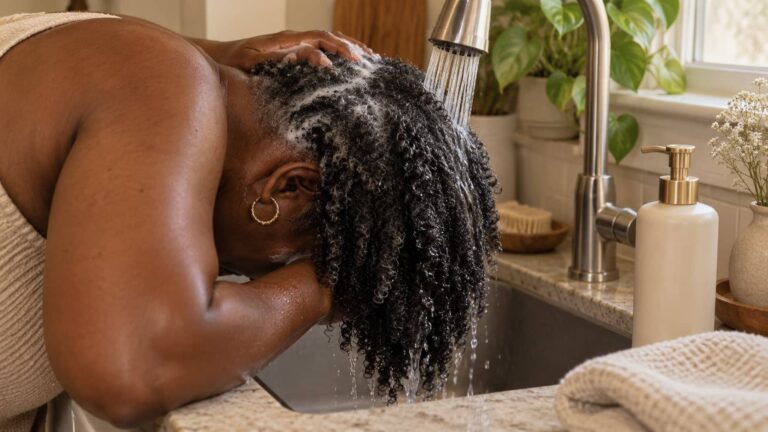
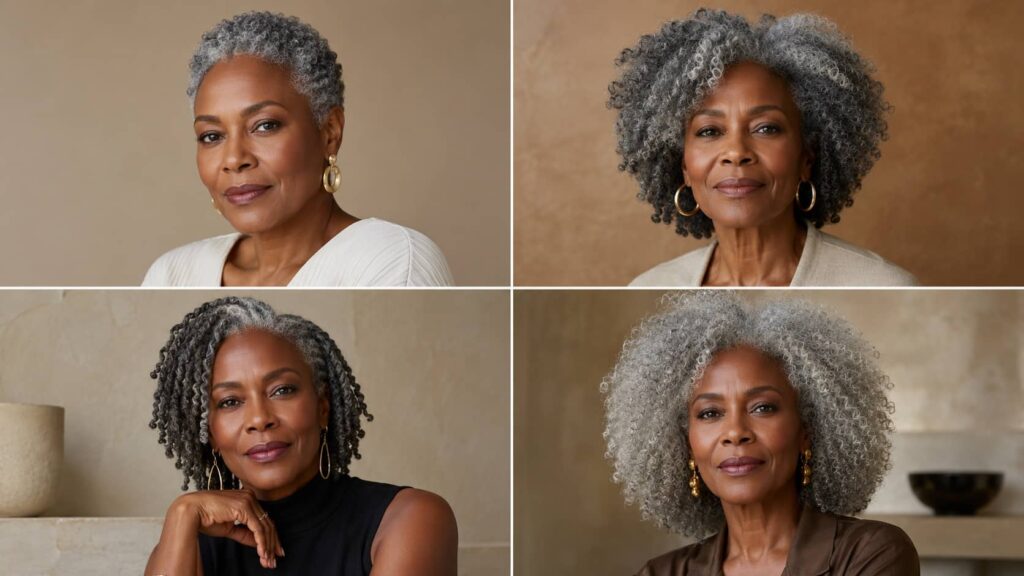
If you are watching gray curly hair come in across your 4C coily texture and wondering why it feels nothing like the hair you have known your whole life, you are not imagining it. Gray hair on coily and kinky textures behaves differently than the hair it replaces.
It is drier, wirier, sometimes coarser, sometimes finer, and it often refuses to do what your old products and your old routine used to make it do. This is the starter kit I would have handed every client who sat in my chair during the gray transition over my 22 years behind it.
Let me walk you through what is happening, why it is happening, and exactly what to put in your hands to make this transition feel less like a fight and more like a homecoming.
Why Gray Curly Hair Feels So Different on 4C Textures
Gray hair is not just hair without color. When a strand goes gray, the follicle stops producing melanin, the pigment that gives hair its color. But the change goes deeper than color alone. As the follicle ages, it also produces less of the natural oils that kept your hair soft, and the structure of the strand itself often changes.
On 4C and coily textures, these changes hit harder than on straighter hair. Your hair was already the driest of all hair types, because the tight coils make it difficult for your scalp’s natural oils to travel down the strand. Now gray adds a second layer of dryness on top of the first. The result is hair that can feel wiry, rough, brittle, and stubborn in ways your pre gray hair never did.
Many women describe their first gray coily strands as feeling like a different texture entirely. Coarser. More resistant. Harder to define. Some women find their curl pattern loosens slightly in the gray sections. Others find it tightens. Both are normal. The strand has genuinely changed, and your hair care has to change with it.
Why Is My Gray Hair Coming In Curly, Coarse, or Wiry
This is one of the most common questions women ask during the transition, and the answer is reassuring. Why is my gray hair coming in curly or coarse is not a sign that something is wrong. It is a sign that your follicle is aging the way every follicle ages.
As the follicle ages, its shape can shift slightly, and the shape of the follicle determines the shape of the strand.
A small change in the follicle can make a gray strand grow in with a different curl pattern, a different thickness, or a wiry quality that stands apart from the rest of your hair. The reduced oil production makes these gray strands feel rougher to the touch. The lower moisture content makes them more prone to frizz and breakage.
None of this means your hair is damaged. It means your hair is changing, and the change is asking you for more moisture, gentler handling, and a slightly different set of products than you used before.
The Yellowing Problem and How to Fix It
One frustration unique to gray curly hair is yellowing. Your beautiful silver and white strands can take on a dull yellow or brassy cast over time, and it can make even healthy hair look tired.
Yellowing on gray coily hair comes from a few sources. Product buildup. Hard water minerals. Environmental pollution. Sometimes the natural oils themselves. Because coily hair is washed less frequently than straighter hair, buildup has more time to accumulate and discolor the gray.
The fix is a purple shampoo or purple toning product used occasionally, not constantly. Purple sits opposite yellow on the color wheel, so it neutralizes the brassiness and brings back the clean silver tone. Use it once every week or two, not every wash, because overuse can leave a faint lilac tint on very white hair. Follow it immediately with a deep conditioner, because purple shampoos can be drying and your gray coily hair cannot afford extra dryness.
A clarifying treatment with chelating ingredients every few weeks also helps, especially if you have hard water. Chelators bind to the minerals that dull and yellow the hair and rinse them away, letting your true silver shine.
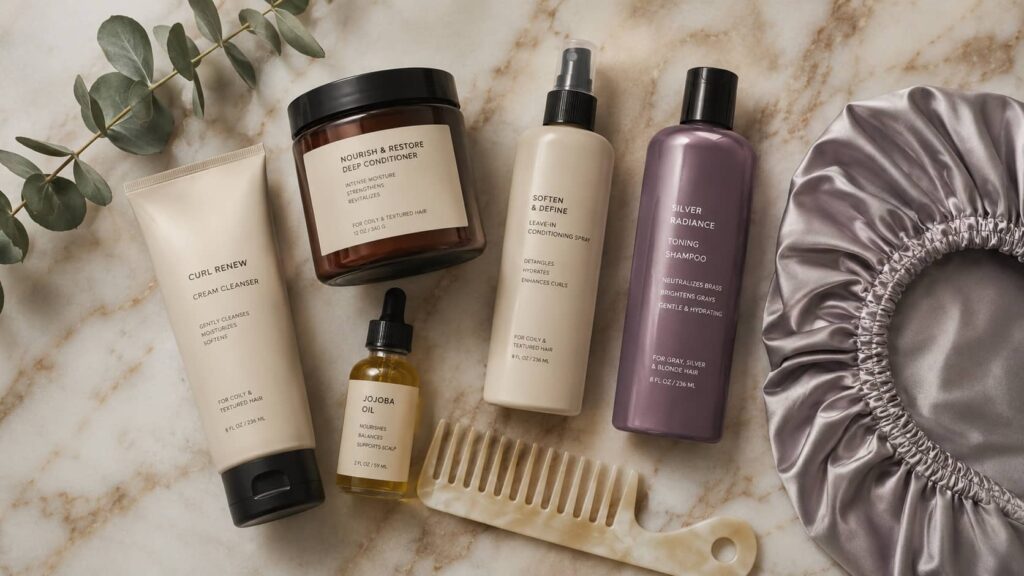
The Gray Curly Hair Starter Kit: Products That Actually Work
Here is what I would put in your hands for the gray coily transition. Think of these as 4C hair type products chosen specifically for the gray stage.
A creamy, sulfate free cleanser or a cowash. Gray coily hair cannot handle stripping cleansers. A gentle cream cleanser or a cleansing conditioner keeps the moisture in while still cleaning the scalp.
A rich, slip heavy deep conditioner. This is the workhorse of the gray transition. Use it weekly. Look for ingredients like shea butter, glycerin, and natural oils. Leave it on for twenty to thirty minutes under a plastic cap to let the moisture penetrate the wiry strands.
A leave in conditioner. Apply to soaking wet hair, every wash, no exceptions. This is the layer that keeps gray coily hair soft between washes.
A sealing oil or butter. After your leave in, seal the moisture in with an oil like jojoba, which is light and close to the scalp’s natural oil, or a richer butter for very dry strands. This step matters more for gray hair than it ever did before, because the strand is no longer holding moisture on its own.
A purple toning shampoo or mask. Used every week or two to fight yellowing and keep your silver clean and bright.
A clarifying or chelating treatment. Used every few weeks to remove buildup and mineral deposits that dull the gray.
A wide tooth comb and a satin bonnet or pillowcase. Gray coily hair is more fragile and more prone to breakage. Detangle gently with a wide tooth comb on wet, conditioned hair, never dry. Sleep on satin to reduce friction and moisture loss overnight.
That is the kit. Six products and two tools. You do not need more than this to care for gray coily hair well.
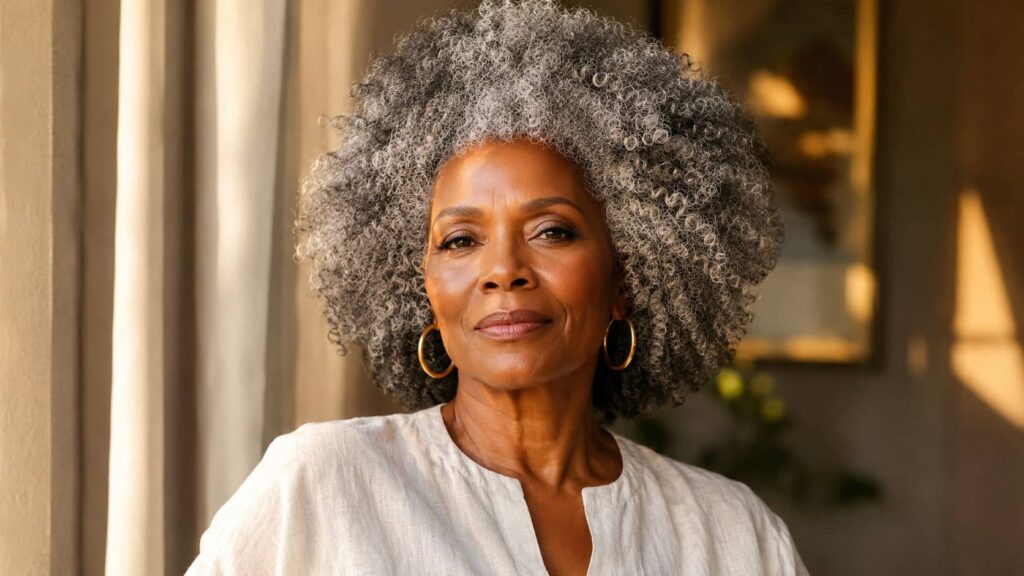
How to Define Gray 4C Curls and Keep Them Soft
How to define 4C curls in the gray stage comes down to moisture first, definition second. Dry gray coils will not clump or define no matter what styling product you use. Soft, hydrated gray coils define beautifully.
Start with soaking wet hair, never damp. Apply your leave in conditioner and rake it through with your fingers or a wide tooth comb. Then apply a curl defining cream or gel in sections, smoothing it down each section to encourage the coils to clump.
Some women find that gray coily strands respond well to a slightly heavier styling product than they used before, because the extra weight helps tame the wiriness.
Let the hair air dry or diffuse on low heat. Resist touching it while it dries, because handling wet coils breaks up the definition and creates frizz. Once dry, you can gently separate and fluff for volume.
If your gray strands stand up and refuse to lie down with the rest of your hair, that wiriness usually softens over time as more of your hair transitions and as your moisture routine takes hold. Patience and consistent moisture are the real tools here.
The Honest Truth About the Gray Coily Transition
One last thing, because every post on this site ends with the truth.
The gray coily transition is not quick, and it is not always comfortable. There will be a stage where you have a line of demarcation between your colored ends and your gray roots, and that stage tests everyone’s patience.
There will be days when the wiry strands do their own thing. There will be a learning curve as you figure out which products your changed hair responds to, because the products that worked for thirty years may not be the ones that work now.
But here is the truth worth holding onto. Gray coily hair, cared for well, is some of the most striking hair there is. Silver against deep skin is a combination that stops people in their tracks. The women I watched transition fully to gray in my chair did not look older. They looked like themselves, turned up. More distinct. More commanding. More undeniably them.
The transition asks for moisture, patience, and a willingness to learn your hair again. Give it those three things, and the hair that grows in will not be a loss. It will be a crown you grew yourself.