Skincare for Menopausal Skin and Melanin Rich Beauty
Why is my skincare not working? If you have asked yourself that at the bathroom sink after 45, you are not imagining things. The moisturizer you trusted for years may suddenly feel too light, your cleanser may start to sting, and your skin may feel dry, tight, dull, or more reactive than it used to.
You stand at the bathroom sink one morning and the moisturizer you have used for years is not behaving the way it used to.
It sits on your cheek like a thin film. You pat it in again. Still nothing. Underneath, your skin feels tight in a way you do not remember. For a second, you wonder if the brand changed the formula. Maybe the store sold you an old jar. Maybe the weather is different. Maybe you are imagining it.
You are not imagining it.
Sometimes the product has not changed at all. Sometimes the thing that changed is your skin.
If you have crossed 45, or 48, or 52, and your once reliable skincare routine suddenly feels as if it has stopped working, you are not alone. Many women notice some version of this shift in midlife. The cleanser that suddenly stings. The cream that no longer feels rich enough. The foundation that breaks down by noon. The skin that feels dry and tight, but still breaks out. The dark mark that used to fade in a few weeks but now lingers for months.
I saw versions of this for years behind the salon chair.
Women would mention it casually at first. Their skin felt different. Their makeup was not sitting right. Their hair was changing too. Their scalp felt drier. Their edges felt more fragile. They were not always looking for a dramatic transformation. Most of the time, they simply wanted to understand what had changed.
This is not a flaw in you.
And it is not always a flaw in your products.It is often a real shift in the skin you are living in now. Once you understand what may be happening underneath, you can stop fighting your skin and start caring for it differently.
This is the kind of conversation I wish more women were given before they started blaming themselves or buying five new serums out of frustration.
What Is Actually Happening to Your Skin After 45?
Let us start by naming the change, because naming it often brings relief.Around the mid forties and beyond, the skin may begin to behave differently. It may feel drier. It may become more sensitive. It may react to products that never bothered it before. It may feel tight by midday. Makeup may settle into lines more easily. Foundation may oxidize faster or look duller against the skin.
Some of this can be connected to the hormonal changes that happen during perimenopause and menopause.
As estrogen levels shift, the skin can lose moisture, firmness, and some of the resilience it had before. The American Academy of Dermatology says skin can lose about 30 percent of its collagen during the first five years of menopause, followed by continued collagen loss over time. That can affect firmness, thickness, dryness, and the way the skin feels day to day.
There are clinical terms for some of what may be happening. You may hear phrases like skin barrier damage, menopausal skin, collagen loss, or hormonal acne. Those words can sound intimidating, but they are simply ways of describing what many women notice in real life.
The skin no longer holds moisture the same way.
It may become easier to irritate.
It may recover more slowly.
It may feel both dry and breakout prone.
It may look duller, even when you are using the same products.
For Black women and women with darker skin tones, there is another important layer. When skin becomes irritated, dark spots can follow. The AAD notes that irritation from skin or haircare products can cause dark spots in darker skin tones, and that using gentler products can help reduce new irritation related marks.
So when your skincare starts failing after 45, it is not a small vanity concern. It can be a sign that your skin is entering a new chapter and needs a routine that respects that chapter.
Why Is It Happening Now?
Here is the simple version.
Your skin has a barrier. That barrier is the outer protective layer that helps keep moisture in and irritants out. When the barrier is strong, skin feels comfortable, balanced, and more resilient. When it is weakened, skin may feel tight, dry, itchy, reactive, or easily irritated.
During perimenopause and menopause, hormonal shifts can affect how the skin behaves. Oil production may decrease. Skin may feel drier. Collagen loss can affect firmness and texture. The skin may also become more vulnerable to irritation, which matters especially when you are dealing with melanin rich skin and hyperpigmentation.
That is why the moisturizer you used for years may suddenly feel too light.
It is not that your skin has become difficult. It is that the old routine may have been built for a younger, oilier, more resilient version of your skin.
The cleanser that once made your face feel fresh may now leave it tight.
The toner that once felt clarifying may now sting.
The exfoliant that once gave glow may now create irritation.
The lightweight lotion that once worked may no longer seal in enough comfort.
The foundation shade that once matched may look different when the skin underneath is drier, duller, or more textured.
Skin also renews more slowly with age. When cell turnover slows, dullness can build. When the barrier is weaker, irritation becomes more likely. When dark spots appear, they may take longer to fade. The AAD explains that dark spots in darker skin tones can take months to fade, and deeper discoloration can take longer.
This is why panic buying rarely helps.
If the skin is already stressed, adding more active products can make the problem worse. What mature skin often needs first is not more aggression. It needs more support.
What May Help Your Skin Now?
Once you understand what your skin may be doing, the solution becomes less about buying an entirely new shelf of products and more about changing the shape of your routine.
Most women do not need twenty steps.
They need a routine that is calmer, richer, more protective, and more consistent.
Switch to a gentler cleanser if your skin feels tight after cleansing, your cleanser may be too harsh for this season of your skin.
Foaming cleansers, strong gel cleansers, menthol based products, and anything that leaves the face squeaky clean can be too stripping when the skin barrier is already struggling. A cream cleanser, milk cleanser, balm cleanser, or gentle hydrating cleanser may be a better fit.
The goal is not to scrub your face into freshness.
The goal is to cleanse without leaving your skin feeling punished. Layer hydration before moisture. A common mistake after 45 is expecting one cream to do everything.
Hydration and moisture are related, but they are not exactly the same. Hydrating ingredients help bring water into the skin. Moisturizing ingredients help soften, protect, and reduce water loss.
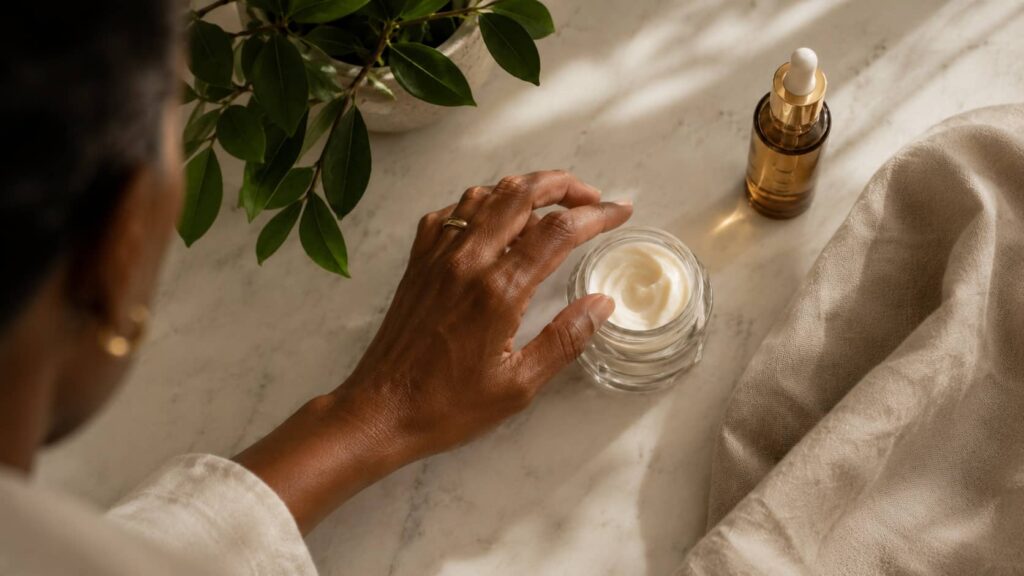
That is why a more supportive routine may include a hydrating step before your moisturizer. Ingredients like glycerin and hyaluronic acid can help bring water to the skin. A moisturizer with ceramides, squalane, shea butter, or nourishing oils can help seal in comfort.
Apply hydrating products to slightly damp skin, then follow with moisturizer. That small change can make the skin feel more comfortable without making the routine complicated.
Add barrier supporting ingredients. When the barrier is struggling, it needs help rebuilding comfort.
Look for moisturizers or serums with ingredients such as:
Ceramides
Glycerin
Squalane
Niacinamide
Panthenol
Peptides
Shea butter
Hyaluronic acid
These ingredients are not about chasing a trend. They are about helping the skin feel calmer, softer, and more supported.
Niacinamide can be especially useful because it supports the skin barrier and may help with uneven tone. Peptides and retinol are also ingredients the AAD mentions as options that can support collagen in menopausal skin, but they should be introduced thoughtfully and not all at once.
Reduce harsh products
This is the part many women resist because they feel they need stronger products to get results. But if your skin is stinging, flaking, burning, breaking out, or becoming darker in patches after irritation, stronger is not always smarter.
Consider pausing:
Alcohol based toners
Strong scrubs
Too frequent exfoliation
High strength acids
Multiple actives used at once
Fragranced products that make your skin sting
Cleansers that leave your face tight
For melanin rich skin, irritation is not just temporary discomfort. It can leave a mark. If a product burns or stings, the AAD advises stopping products that irritate the skin when dealing with dark spots.
That is not weakness.
That is wisdom.
Add one active at a time
Once your skin feels calmer, you can begin adding actives.
But add them slowly.
For many women, niacinamide is a gentle first active. Vitamin C can be useful for dullness and dark spots. Retinol can support texture and fine lines, but it should be introduced gradually. The AAD suggests that beginners may start retinoids slowly, such as every other night, to help build tolerance.
The mistake is adding Vitamin C, retinol, exfoliating acids, and brightening serums all in the same week because your skin suddenly feels unfamiliar.
That is not a routine.
That is an ambush.
Give your skin one new thing at a time. Then listen.
Wear sunscreen every morning
This is not optional if you are dealing with dark spots, uneven tone, or mature skin.
For darker skin tones, visible light can worsen hyperpigmentation, and tinted sunscreens with iron oxides can help protect against visible light while also reducing white cast. The AAD recommends tinted broad spectrum sunscreen with SPF 30 or higher for darker skin tones, especially when dark spots are a concern.
This matters because a brightening serum without sunscreen is like mopping the floor while the tap is still running.
You may see some improvement, but you are working against yourself.
Where to Actually Start
If I were sitting with you and rebuilding your routine from the beginning, I would keep the first two weeks very simple.
Morning:
Gentle cleanser or a water rinse if your skin is very dry
Hydrating serum or essence on damp skin
Moisturizer with barrier support
Tinted broad spectrum sunscreen with SPF 30 or higher
Evening:
Gentle cleanser
Hydrating serum or essence
Moisturizer with ceramides, glycerin, peptides, squalane, or shea butter
Richer cream if your skin feels dry overnight
That is enough at first.
No scrubs.
No new exfoliating acid.
No retinol yet if your skin is irritated.
No rotating five new products because a video said they worked miracles.
Give your skin two weeks of calm.
In that time, you may notice less tightness, less stinging, fewer flakes, better makeup application, and a softer feeling overall. If your skin begins to settle, then you can add one active.
I would usually start with niacinamide because it is supportive and tends to be easier to tolerate. After that, depending on your concern, you might add Vitamin C in the morning or a gentle retinol at night.
If you are dealing with stubborn hyperpigmentation, melasma, acne, rosacea, eczema, sudden sensitivity, or skin that does not calm down after a month of gentle care, it is time to speak with a dermatologist. A good dermatologist, especially one familiar with darker skin tones, can help you avoid months of guessing.

That is not failure.
That is care.
The Honest Truth About Why Skincare Stops Working
Here is the truth.
Your products may not have betrayed you.
Your skin may simply have changed.
The routine that worked at 32 may not support the skin you have at 48. The cleanser that felt fresh at 35 may feel harsh at 50. The moisturizer that used to be enough may no longer give your barrier what it needs. The foundation that once looked smooth may need a different preparation underneath.
This is not a tragedy.
It is a transition.
But the beauty industry does not always prepare women for transitions. It sells solutions, but it does not always explain seasons. It sells glow, but it does not always explain dryness. It sells anti aging, but it does not always respect the woman who is aging.
So let us be honest.
No moisturizer will undo menopause.
No serum will rebuild lost collagen overnight.
No product will give you the skin you had at 30.
No brightening cream will work properly if sunscreen is missing.
No active ingredient can do its best work on a damaged barrier.
The goal after 45 is not to chase the skin of your past.
The goal is to understand the skin you have now.
To keep it comfortable.
To keep it protected.
To support its glow.
To reduce irritation.
To care for dark spots with patience.
To build a routine that respects melanin rich skin and mature beauty.
If you spend this season chasing who you used to be, you may spend a lot of money and still feel frustrated.
If you spend this season learning the woman you are becoming, your routine becomes clearer. Your skin becomes calmer. Your choices become more considered.
The bottle on the bathroom counter is one tool.
You are the woman learning how to use it.
And that is where the real shift begins.