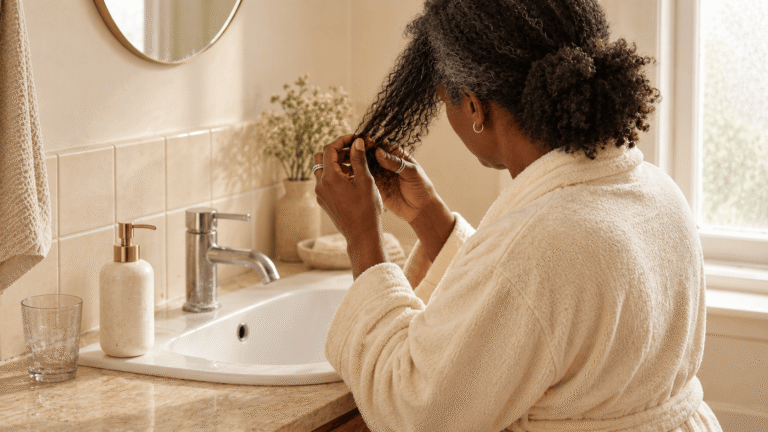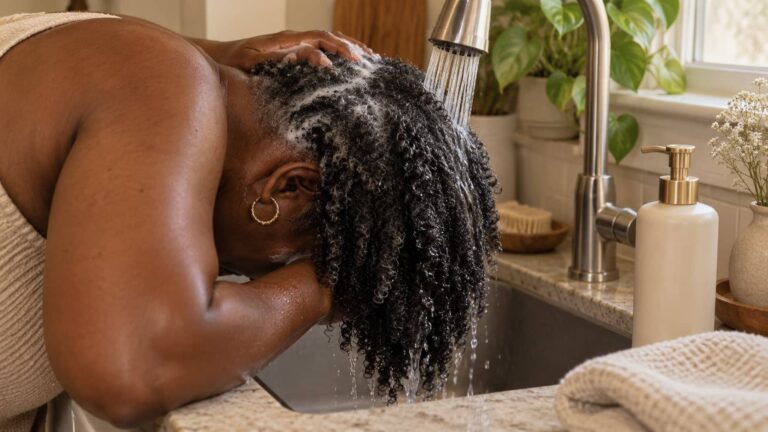
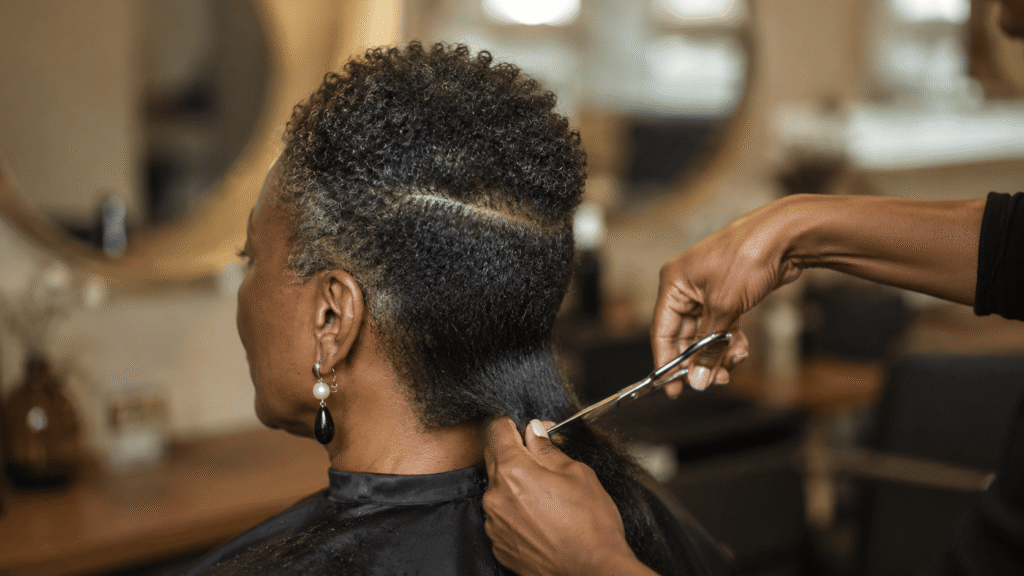
Cutting away the relaxer, meeting your natural texture and discovering the hair you have now
Big chop decisions can feel emotional at any age, but after 50 they can carry decades of hair history with them.
For a younger woman, going natural may be about discovering a texture she has only recently started chemically straightening. For a Black woman in her fifties or sixties, the story can be very different.
You may be cutting away thirty or forty years of relaxers.
You may be seeing your natural texture properly for the first time since you were young.
And underneath the colour you have been applying for years, you may also discover something else.
Your natural grey.
During my 22 years behind the salon chair, I watched women make this transition for many different reasons. Some were tired of breakage. Some wanted freedom from relaxers. Some wanted a simpler relationship with their hair. Others simply reached a point where they no longer wanted to hide what naturally grew from their scalp.
The big chop is not the only way to go natural, and it is not automatically the right choice for every woman.
But when a woman is ready for it, it can be much more than a haircut.
It can be the moment she finally meets the hair she has now.
What Is the Big Chop?
The big chop is when you cut away relaxed, chemically straightened or severely damaged lengths so that you are left with your natural texture.
For some women, that means cutting very close to the scalp.
For others, it means growing several inches of natural hair first and then cutting away the remaining relaxed ends.
There are really two main ways of transitioning from a relaxer to natural hair.
You can transition slowly, allowing your natural roots to grow while gradually trimming the chemically treated ends.
Or you can do the big chop and remove those treated lengths much sooner.
Neither approach makes you more natural than the other.
The difference is mainly how long you want to live with two textures.
During a long hair transition, your natural roots and relaxed lengths behave differently. The point where the two textures meet can be particularly vulnerable to breakage, so handling becomes important.
The big chop removes much of that two-texture challenge in one decision.
But it also means being ready to see yourself with much shorter hair.
And sometimes that is the part that requires the most courage.
For many Black women, going natural can also be connected with identity, cultural pride and the freedom to wear hair in its natural state.
After 50, that can carry an especially personal meaning.
You are not simply discovering a curl pattern.
You may be meeting a part of yourself you have not seen for decades.
Why Black Women Do the Big Chop
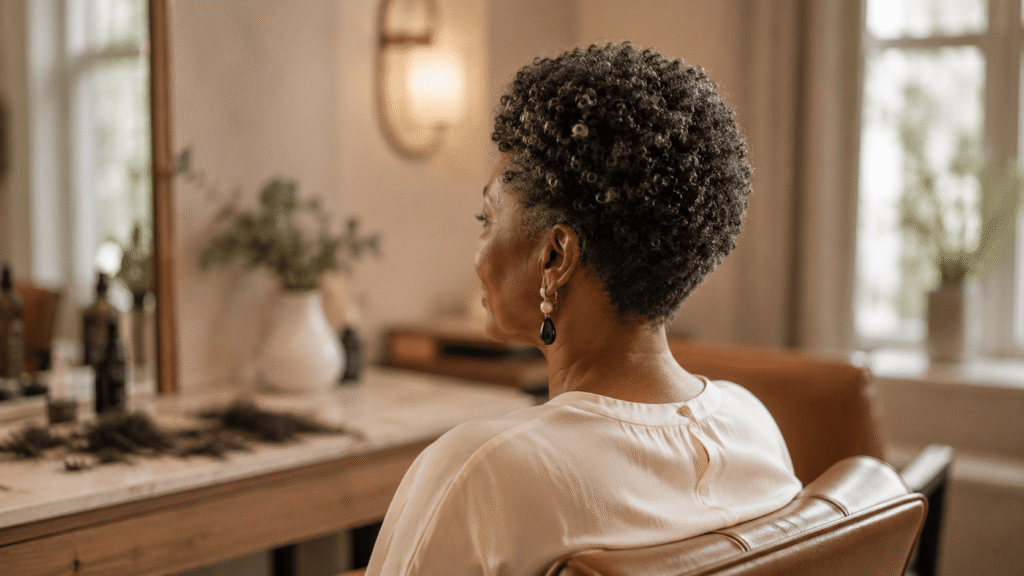
There is no single reason Black women decide to do the big chop.
For some, the reason is practical.
Repeated relaxing can weaken hair, especially when relaxer overlaps onto previously treated lengths. Add frequent heat, colour, tight styling or rough handling, and the hair you have now may become increasingly vulnerable to dryness and breakage.
At some point, a woman may decide that she no longer wants to keep preserving damaged ends.
She wants to start again with her new growth.
For other women, the decision has less to do with damage and more to do with freedom.
For years, many of us used relaxers and chemical straightening because straight hair could feel more acceptable, more polished or simply more expected.
That does not mean every woman who relaxes her hair dislikes her natural texture.
I would never make that assumption.
A woman may relax her hair because she loves the style, finds it easier to manage or simply prefers how it looks.
Choice matters.
But there is a difference between choosing straight hair because you enjoy it and feeling that your natural hair cannot comfortably be presented to the world.
That is something I understand personally.
A Personal Note
I have not done my own big chop yet.
For much of my life, I wore extensions and kept my natural hair covered because that was simply how I felt comfortable presenting myself where I live.
Only in more recent years have I become confident enough to wear my braids freely.
But I carry a quiet dream.
When I retire, I would like to go short and natural and finally meet my own hair the way it truly is.
So when I write about the big chop, I am speaking from two places.
I am the former salon owner who guided women through their hair transitions.
And I am also the woman who understands why cutting all that history away can feel like such a big decision.
The Big Chop After 50 – What Is Different?
A big chop at 55 or 60 may not feel the same as one at 25.
For one thing, the natural hair you meet may not behave exactly as you remember it.
Ageing and hormonal changes can affect dryness, density and strand diameter. Some women also notice thinning on the scalp or a widening part around and after menopause.
That is why it is important not to assume that every change you see after the big chop is simply your new curl pattern.
A haircut can remove damaged lengths.
It cannot treat hair loss.
If you notice a widening part, smooth bald patches, a receding hairline, scalp pain, persistent itching, unusual scaling or significant thinning, have the scalp examined by a dermatologist rather than trying to solve it with another hair product.
There is another difference after 50 that has nothing to do with biology.
You may care less about what everybody else thinks.
That can be wonderfully freeing.
At 25, cutting off most of your hair may come with endless questions.
Will people think I look feminine?
Will my partner like it?
Will my face look too exposed?
Will I know how to style it?
What will people at work think?
Later in life, many women arrive at a different question.
Do I like it?
That shift matters.
You are no longer chopping your hair because natural hair is having a fashionable moment.
You are doing it because you have decided that the hair growing from your own scalp deserves to be known.
Hair Transition: Your True Texture and Natural Grey Hair
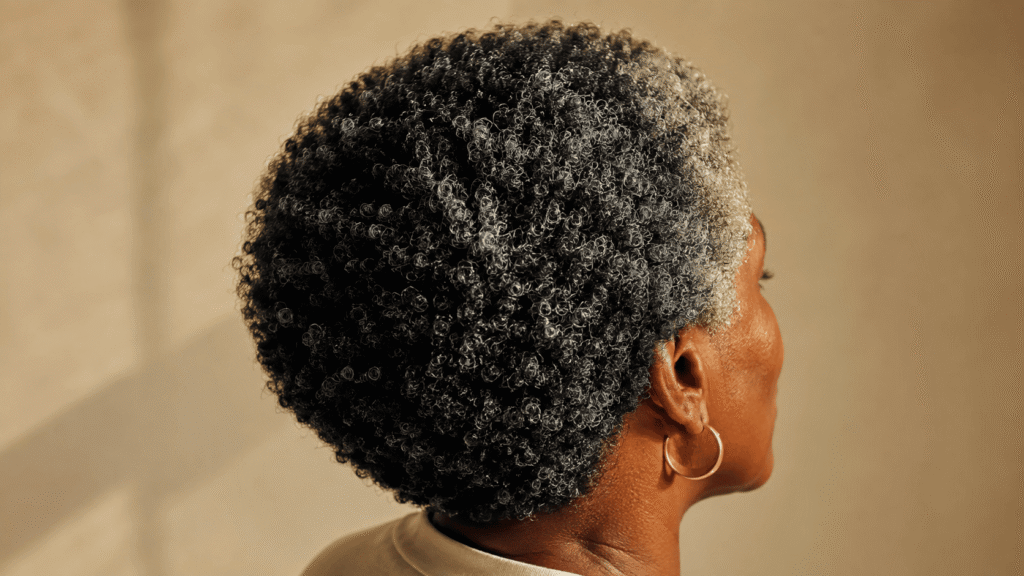
This is one of the most beautiful parts of going natural later in life.
You may meet two things at once.
Your natural texture.
And your natural colour.
If you have relaxed and coloured your hair for years, you may not know exactly how much natural grey hair is underneath until you begin allowing your new growth to remain untouched.
That can be a surprise.
For some women, it is an uncomfortable one at first.
We have been taught for so long to treat grey hair as something that needs to be covered that seeing a full head of silver coils can take some getting used to.
But grey does not automatically make natural hair less beautiful.
Against deep melanin skin, silver, charcoal, salt and pepper and white coils can be striking.
I saw that many times in the salon.
A woman would worry that allowing the grey to show would make her look older.
Then the colour would grow in alongside her natural texture and suddenly the combination looked completely intentional.
Not old.
Distinctive.
From the Salon Chair
The women I saw embrace both their natural texture and their grey often seemed to carry themselves differently afterwards.
Not because a haircut magically transformed their confidence.
But because there was less hiding.
Less maintenance designed around covering what naturally belonged to them.
And more curiosity about what their own hair could actually do.
If your natural grey hair appears after the big chop, do not rush to cover it unless you truly want to.
Give yourself time to see it first.
You may discover that the colour you spent years concealing is one of the most distinctive things about your hair now.
Caring for Your Hair After the Big Chop
Once the treated ends are gone, the goal is not to immediately replace one complicated routine with another.
Start by learning the hair you actually have.
Black hair is especially fragile and prone to damage, so gentle handling matters.
Your new routine may be surprisingly simple:
- Cleanse regularly. Keep your scalp clean enough to prevent heavy product buildup. How often you wash depends on your scalp, styling routine and lifestyle.
- Condition after washing. Conditioner helps improve softness and slip, particularly through the ends and more fragile areas.
- Add moisture while the hair is damp. A leave-in conditioner or moisturising product can be particularly useful for coily hair that feels dry.
- Use creams, butters or oils according to what your hair actually needs. They can soften the strand and help reduce moisture loss, but piling on more product is not the same as adding more hydration.
- Be especially gentle with a fragile hairline or thinning edges. Avoid styles that pull tightly enough to hurt or place repeated tension on the same areas.
- Detangle with slip. Many coily textures are easier to detangle when damp or wet and coated with conditioner. Work in sections and do not rush.
- Protect the hair overnight. A satin bonnet, scarf or pillowcase can help reduce friction while you sleep.
- Be careful with heat. Natural hair does not become indestructible simply because the relaxer is gone.
Your scalp also needs regular cleansing so product buildup does not quietly become part of the problem.
One thing I would not do is immediately buy ten products labelled for natural hair.
Give yourself time.
Your hair will tell you what it needs.
Short Natural Hair After 50: Learning the New Shape
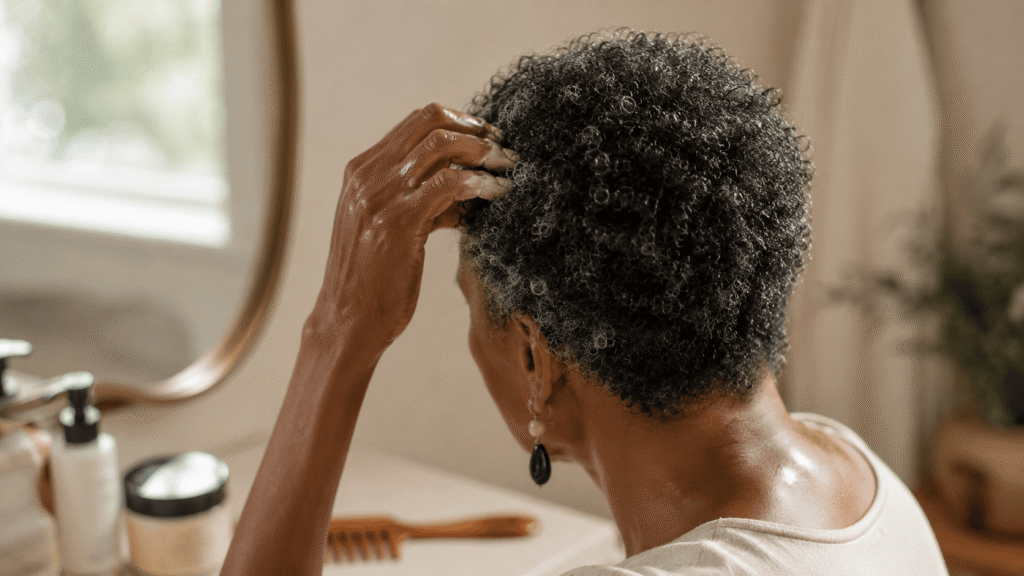
For many women considering the big chop, the real fear is not natural hair.
It is short hair.
That deserves to be said.
If you have worn shoulder-length hair, extensions, wigs or long relaxed styles for years, suddenly seeing your ears, forehead, neck and entire face can feel very exposing.
You may love it immediately.
You may not.
Both reactions are allowed.
The short stage is not something you have to hurry through.
A beautifully shaped TWA, tapered cut, soft coils or silver cropped Afro can be a complete hairstyle in its own right.
Short natural hair can also give you the opportunity to learn your texture without being overwhelmed by length.
You can see where it coils tightly.
Where it is softer.
Where it needs more moisture.
Where the grey behaves differently.
Where the density has changed.
And as the hair grows, you learn it gradually.
I would also resist the idea that short natural hair is automatically low maintenance.
For some women, it is wonderfully simple.
For others, learning an entirely new texture takes time.
The objective is not to prove that natural hair is easier.
The objective is to find a routine that respects it.
Going Natural After 50 Is Not About Rejecting Everything You Did Before
There is one thing I want to make clear.
Going natural does not require you to be ashamed that you ever relaxed your hair.
I spent much of my professional life working with women who wore relaxed hair beautifully.
I wore extensions myself.
Those choices are part of our history too.
The point is not to look backwards and judge the woman you were.
She made choices according to her time, her culture, her work, her preferences and what beauty looked like around her.
Going natural after 50 can simply mean that what you want now has changed.
That is allowed.
You can love the woman who wore the relaxer and still become the woman who wears her coils.
You can enjoy extensions sometimes and still love your natural hair.
You can colour your grey because you love colour.
Or you can stop colouring it because you want to see what has been growing underneath.
Natural hair should not become another beauty rule.
It should be another choice.
Frequently Asked Questions
What is the big chop?
The big chop is cutting away relaxed, chemically straightened or severely damaged lengths so that you are left with your natural texture. Some women cut almost immediately, while others grow several inches of natural hair first and then remove the remaining treated ends.
Is 50 too old for the big chop?
No. There is no age limit for going natural. A big chop after 50 can be particularly meaningful for a woman who has relaxed or straightened her hair for decades and is ready to discover the natural texture she has now.
Is the big chop the only way to go natural?
No. You can transition gradually by growing your natural roots and trimming the relaxed ends over time. The big chop simply removes the chemically straightened lengths sooner.
How do I transition from a relaxer to natural hair without doing the big chop?
Allow the new growth to come in while gradually trimming the relaxed ends. Keep both textures conditioned, minimise rough handling and heat, and pay particular attention to the point where the natural and relaxed hair meet because it can be more vulnerable to breakage.
Will my hair be grey after the big chop?
If you have been colouring your hair, your new growth may reveal natural grey that was previously hidden. How much grey you have is individual. You can keep it, colour it or change your mind later. The important thing is that the choice is yours.
How should I care for my hair after the big chop?
Start simply. Cleanse the scalp regularly, condition the hair, add moisture while it is damp, detangle gently, avoid unnecessary tension and protect the hair from excessive heat and friction. Add products according to what your own hair needs rather than buying an entire natural-hair routine at once.
Does the big chop make hair grow faster?
No. Cutting off relaxed or damaged lengths does not change the growth rate at the follicle. What it can do is remove damaged ends and make it easier to concentrate on gentle care and length retention as new hair grows.
The Honest Takeaway
The big chop after 50 can be practical, emotional or both.
It can mean removing damaged relaxed ends.
It can mean ending a long hair transition.
It can mean discovering your natural grey.
And sometimes it means looking in the mirror and seeing your own texture properly for the first time in decades.
But you do not have to do it to prove anything.
You do not have to hate relaxers.
You do not have to reject extensions.
You do not have to become somebody else’s idea of what a natural Black woman should look like.
Whether you do your big chop tomorrow or hold it as a someday dream the way I do, the important thing is that the decision belongs to you.
Your natural hair was never something that needed an apology.
It may simply have been waiting for you to become curious about it again.
The big chop is not losing your hair. It is meeting it.
No relaxer.
No hiding.
No apology.
That is what The Melanin Tone is here for, helping Black women over 50 care for their hair and themselves with knowledge instead of fear.