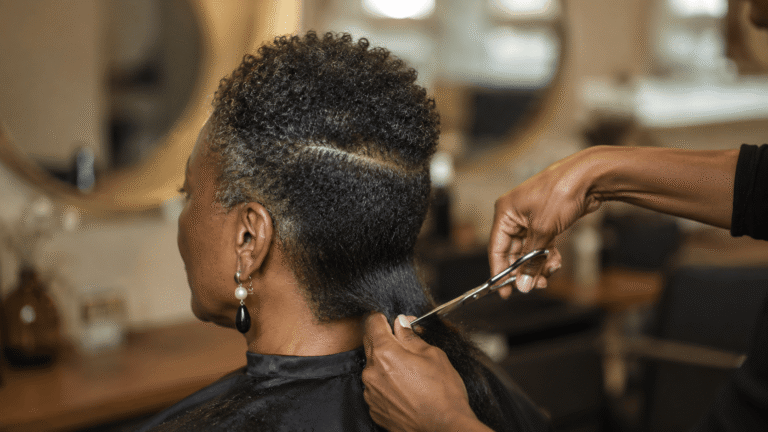

How to remove buildup without turning a useful deep cleanse into another source of dryness.
How often to use clarifying shampoo depends on your hair, the products you use and how quickly buildup returns, but for 4C hair after 50, it should usually be an occasional deep-clean step rather than something you reach for at every wash.
Clarifying shampoo has a useful job.
It removes stubborn residue from styling creams, gels, oils, pomades and other products that an everyday shampoo may leave behind.
But there is a difference between removing buildup and repeatedly cleansing hair more aggressively than it needs.
During my 22 years behind the salon chair, I saw both sides.
Some women needed a proper deep cleanse because months of oils, creams and styling products had left their hair coated and dull.
Others were doing the opposite. They were chasing that squeaky-clean feeling so often that their hair became rougher, harder to detangle and more prone to breakage.
Neither extreme serves 4C hair well.
The real question is not simply, how often should I clarify?
It is:
How do I know when my hair genuinely needs it?
How Often Should You Use Clarifying Shampoo on 4C Hair?
There is no scientifically established schedule saying every woman with 4C hair must clarify every seven, fourteen or thirty days.
Your routine matters too much for that.
A woman who uses a leave in conditioner and very little else may need to clarify far less often than someone layering gel, edge control, butter, oil and styling cream throughout the week.
A sensible starting point for someone who regularly uses several styling products can be around once or twice a month.
But that is a starting point, not a rule.
Very dry hair may need it less often.
Heavy product users may occasionally need it sooner.
The condition of your scalp matters too.
What I would not recommend is putting clarifying shampoo permanently on the calendar without asking whether there is actually something to clarify.
Why 4C Hair Needs a Thoughtful Approach
4C describes a tightly coiled curl pattern. It does not tell us whether an individual strand is fine, medium or coarse.
That distinction matters.
What tightly coiled hair does have is a shape that can make it more difficult for natural sebum from the scalp to travel along the length of the strand.
As a result, many women with 4C hair find that their lengths and ends become dry easily.
Hair can also become more vulnerable to breakage through chemical processing, heat, friction, tight styling and rough handling.
After 50, some women notice additional changes in density, dryness or manageability.
That is why I would use clarifying shampoo with purpose.
You want enough cleansing to remove stubborn residue.
You do not need to keep repeating the process simply because an extremely clean feeling seems healthier.
What Does Clarifying Shampoo Actually Do?
Clarifying shampoo is essentially a deeper cleansing shampoo.
It is designed to remove residue that can accumulate from styling products, oils, silicones, butters, dry shampoo and other substances left on the hair.
You may notice buildup when:
- your hair feels coated even after washing
- your usual products seem to sit on top of the hair
- curls or coils feel weighed down
- the hair looks unusually dull
- you have been using heavier gels, creams, oils or pomades regularly
- you have gone through a period of particularly product-heavy styling
But none of those signs proves that buildup is the only possible cause.
Dryness, damage and hard-water minerals can sometimes make hair feel rough or dull too.
This is why understanding what you are trying to remove matters.
Clarifying Shampoo vs Chelating Shampoo

These two terms are often used as though they mean exactly the same thing.
They do not.
A clarifying shampoo is primarily intended to remove stubborn cosmetic residue such as oils, styling products and other buildup.
A chelating shampoo is formulated with ingredients that can bind certain mineral or metal ions so they can be washed away more effectively.
That becomes particularly relevant with hard water.
Calcium, magnesium and other minerals in water can accumulate on hair over time and affect how it feels and behaves.
Some shampoos can perform both functions, so the words on the front of the bottle do not always tell you everything. The ingredient list and the manufacturer’s intended use matter.
This is also why I would not automatically describe every chelating shampoo as stronger than every clarifying shampoo.
Formulas differ.
If your problem is ordinary styling-product buildup, clarifying may be enough.
If you are specifically dealing with hard-water mineral deposits, look for a product designed to remove mineral buildup or containing chelating agents.
I will deal with chelating shampoo and hard water separately because it deserves its own explanation.
Signs You May Be Clarifying More Often Than Your Hair Needs
There is no single symptom that proves you have over-clarified your hair.
But there are clues worth paying attention to.
If, after clarifying, your hair repeatedly feels rougher than usual, tangles more easily, becomes difficult to manage or seems noticeably drier despite conditioning, the formula or frequency may be too aggressive for your hair.
You may also notice more breakage during detangling or a scalp that feels tight or uncomfortable after washing.
Grey hair can sometimes already feel different in texture or behave differently from pigmented strands, so an unnecessarily aggressive cleansing routine may make those differences more noticeable.
The important word here is repeatedly.
One unusually dry wash day does not automatically mean your clarifying shampoo is damaging your hair.
Look for a pattern.
And remember that dryness and breakage can have many causes.
If hair is breaking significantly, your edges are disappearing, your part is widening or your scalp is persistently itchy, painful or inflamed, do not assume clarifying shampoo is the entire explanation.
Stop Chasing the Squeaky Clean Feeling
This is something I used to see in the salon.
Women sometimes believed the cleaner the hair felt, the healthier it must be.
So they looked for that almost squeaky feeling after shampooing.
I do not use that as my measure of a successful wash.
Clean hair does not need to feel stripped.
If your hair consistently comes out of a clarifying wash rough, tangled and difficult to handle, that is useful information.
It may mean you are clarifying too frequently.
It may mean that particular formula is not right for you.
Or it may mean you did not need such a deep cleanse in the first place.
Clarifying shampoo is a tool, not a routine.
That is the distinction I want women to remember.
Product Buildup Is Not the Same as Dirty Hair
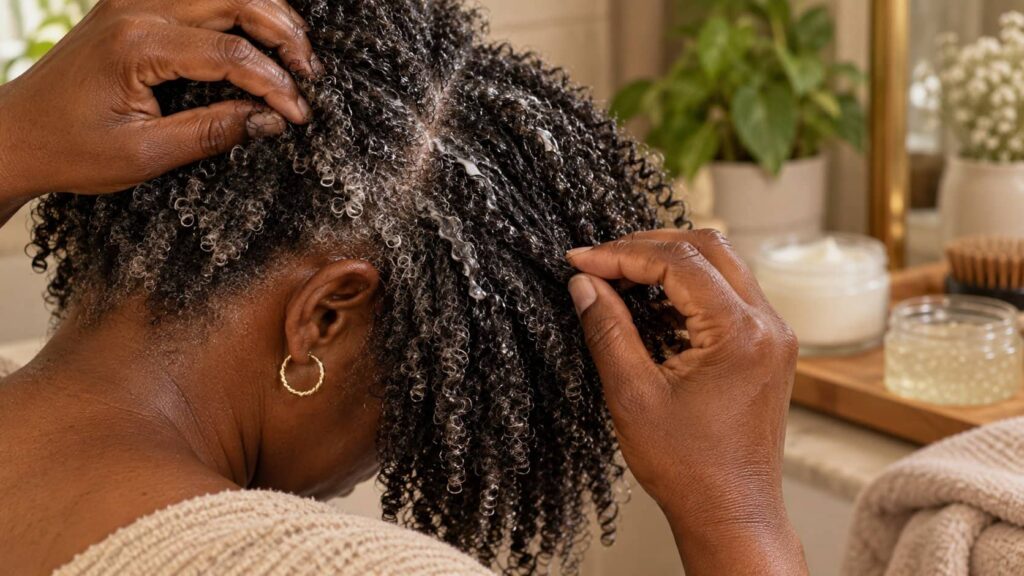
This is important for Black women because our hair routines can involve several layers.
Leave-in conditioner.
Curl cream.
Gel.
Oil.
Edge control.
A butter or styling cream.
Perhaps another layer later in the week to refresh the style.
None of those products is automatically bad.
But together they can create product buildup over time.
That buildup does not mean your hair is dirty or that you have failed to care for it.
It simply means some of the things we use to moisturise, define and protect textured hair do not disappear by themselves.
Occasionally, you need to reset the hair.
That is when clarifying becomes useful.
The mistake is turning an occasional reset into the cleanser you automatically use every wash.
How to Clarify 4C Hair Without Overdoing It
When you genuinely need a deep cleanse, keep the process simple.
Apply the shampoo mainly where cleansing is needed rather than aggressively rubbing the hair lengths together.
Use your fingertips on the scalp, not your nails.
Let the shampoo and rinse water move through the lengths rather than piling the hair on top of your head and scrubbing it.
Then condition.
Conditioner is particularly important after a deeper cleanse because it improves slip, softness and manageability and helps reduce friction during detangling.
If your hair is very dry, a richer conditioner or occasional conditioning treatment may suit you.
Detangle gently while you have good slip and work in sections where necessary.
Then return to your normal moisturising routine.
For most wash days, you do not need a clarifying shampoo.
Use an ordinary shampoo appropriate for your scalp and hair, and save the deeper cleanser for the times when buildup tells you it has earned a place.
What About Co-Washing Between Clarifying Shampoos?
Co-washing can work for some women, but I would not use it as an automatic substitute for shampoo indefinitely.
A conditioner is designed differently from a shampoo.
Some co-wash products contain mild cleansing ingredients, but repeated use of conditioners and styling products without adequate cleansing can also contribute to buildup.
So if co-washing works beautifully for your hair, you do not need to abandon it.
Just pay attention to your scalp.
A scalp that is itchy, flaky, heavily coated or uncomfortable may need proper cleansing rather than another layer of conditioner.
The goal is balance.
Not avoiding shampoo.
Not overusing shampoo.
Mature 4C Hair Needs Observation More Than Rules
One thing I have learned from years of working with textured hair is that women want numbers.
How many days?
How many washes?
How many drops?
How many times a month?
I understand why.
Numbers make a routine feel safe.
But hair does not always cooperate with the calendar.
A woman wearing a protective style may have different needs from a woman washing and styling her short natural hair regularly.
Someone swimming every week has different exposure from someone who does not.
A woman using five styling products has a different buildup pattern from someone using two.
And the woman with fine 4C strands may respond differently from the woman whose 4C strands are genuinely coarse.
So watch your hair.
If it feels clean, soft and responsive to your products, you may not need to clarify yet.
If it feels increasingly coated, weighed down and resistant to your usual routine, a deeper cleanse may be useful.
Then see what happens.
Your hair’s response is information.
Frequently Asked Questions
How often should you use clarifying shampoo on 4C hair?
There is no universal schedule. If you use several styling products regularly, starting around once or twice a month may be reasonable, while very dry hair or lighter-product routines may need it less often. Let genuine buildup and the way your hair responds guide the frequency rather than clarifying automatically every week.
Can I use clarifying shampoo every week?
Some people may tolerate weekly clarifying, but many women with dry or tightly coiled hair will not need such frequent deep cleansing. If your hair becomes rougher, more tangled or noticeably drier after repeated clarifying, reduce the frequency or reconsider the formula.
What is the difference between clarifying and chelating shampoo?
Clarifying shampoo is primarily used to remove styling-product residue, oils and other cosmetic buildup. Chelating products contain ingredients designed to bind mineral or metal ions, making them particularly useful when hard-water mineral deposits are the concern. Some shampoos can do both.
Is clarifying shampoo good for natural hair?
It can be. Natural hair can accumulate residue from gels, creams, oils, butters and other styling products. Clarifying occasionally can help reset the hair, but it does not need to be the cleanser used at every wash.
Can clarifying shampoo damage 4C hair?
Clarifying shampoo is not automatically damaging. The problem is using a cleansing formula more aggressively or more frequently than your hair tolerates. Repeated dryness, roughness, tangling or breakage after clarifying are reasons to reassess how you are using it.
Should I deep condition after clarifying shampoo?
You should condition after clarifying. Whether you need a separate deep conditioner depends on your hair and the product you use. Hair that feels especially dry may appreciate a richer conditioning treatment, but every clarifying wash does not require the same routine for every woman.
Is product buildup the same as hard-water buildup?
No. Product buildup comes from cosmetic products and oils left on the hair. Hard-water buildup involves mineral deposits from the water itself. That is why clarifying and chelating shampoos should not automatically be treated as identical.
The Honest Takeaway
So, how often to use clarifying shampoo on 4C hair after 50?
Not according to somebody else’s calendar.
Use it when there is a reason.
If you regularly use several styling products, once or twice a month can be a sensible place to start. If your hair stays clean and responsive for longer, you may need it less.
If your hair repeatedly comes out of a clarifying wash rougher, more tangled or less manageable, listen to that too.
The goal is not to remove every trace of oil from your hair.
It is to remove the buildup that is getting in the way.
Then stop.
Condition.
Moisturise.
And go back to caring for your hair normally.
After 22 years of working with textured hair, that is still one of the simplest lessons I can give you.
Do not confuse stripped with clean.
Clarify when it helps.
Not simply because the calendar says it is time.
That is how The Melanin Tone approaches hair care for Black women over 50. Understand what your hair needs first, and only then reach for the product.