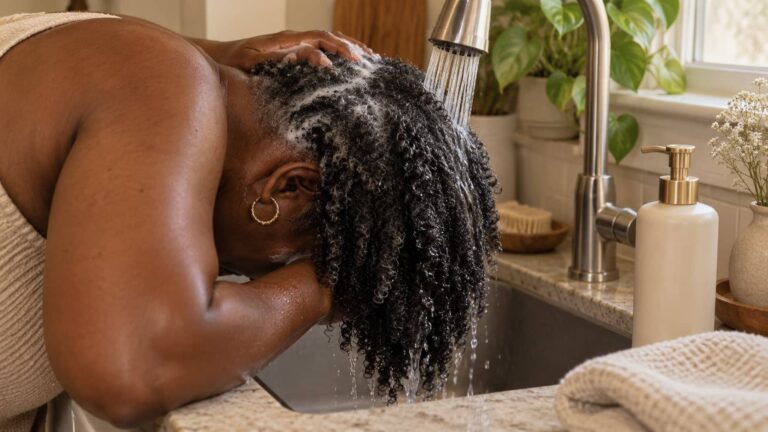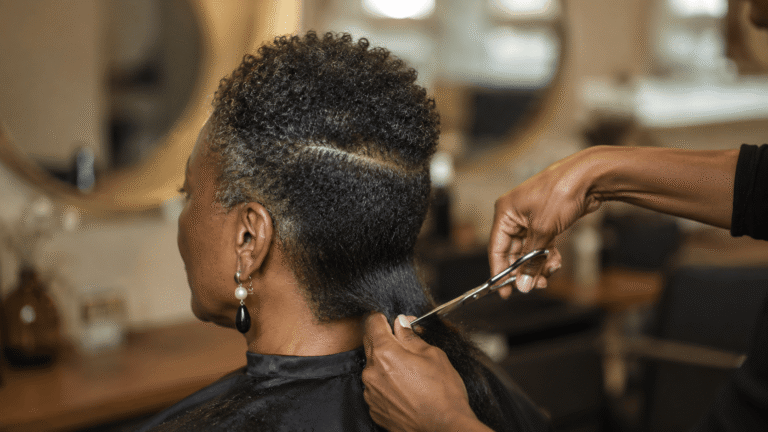

How to remove mineral buildup without mistaking every dry wash day for a hard-water problem.
Chelating shampoo for hard water can be useful when minerals from your water begin accumulating on the hair, but that does not mean every woman with dry 4C hair needs one or that chelating should become part of every wash day.
This is where haircare language gets confusing.
Your hair feels rough.
Your conditioner suddenly does not seem to work as well.
Your coils look dull.
You wash again.
Nothing changes.
So you buy a clarifying shampoo. Then another deep cleanser. Then perhaps a stronger shampoo.
But what if the problem is not another layer of styling product?
What if it is the water?
During my years behind the salon chair, one thing became very clear to me. You cannot solve every kind of buildup with the same approach.
Product residue and mineral deposits are not identical.
And if hard water is contributing to what is sitting on your hair, this is where a chelating shampoo may earn its place.
But only when you actually need it.
What Is Chelating Shampoo?
A chelating shampoo is a cleansing shampoo formulated to help remove mineral and metal deposits that can accumulate on the hair.
This matters particularly if you live in a hard water area.
Hard water contains relatively high levels of dissolved minerals, particularly calcium and magnesium. Depending on the water supply, hair may also be exposed to metals such as iron or copper.
Hair can take up calcium and magnesium from water, and the amount that accumulates can vary according to factors including the condition of the hair, the water and its pH.
A chelating shampoo contains ingredients known as chelating agents.
These ingredients bind certain metal ions, helping them remain soluble so that they can be removed more effectively during washing.
EDTA and related ingredients are among the chelating agents used in cosmetic formulations. You may see names such as disodium EDTA or tetrasodium EDTA on an ingredient list, although other chelating ingredients can also be used.
But there is an important point here.
Simply seeing EDTA somewhere near the bottom of a shampoo ingredient list does not automatically prove that the product is an intensive hard-water treatment. Chelating agents may also be added to cosmetics to improve the stability of the formula itself.
That is why I would look at what the whole product is designed to do, not choose a shampoo based on one ingredient alone.
What Hard Water Actually Does to Hair
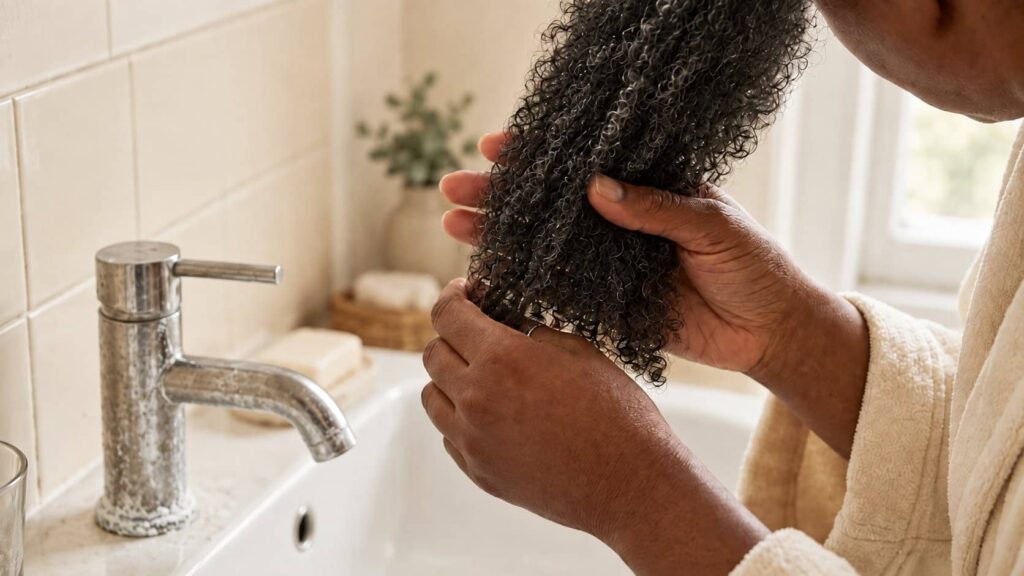
Hard water gets blamed for almost everything.
Dry hair.
Breakage.
Frizz.
Dullness.
Hair loss.
An itchy scalp.
Some of those claims go much further than the evidence allows.
What we do know is that minerals from water can deposit on or be taken up by human hair.
Research has found calcium and magnesium associated with hair after exposure to water, and chemically or oxidatively damaged hair may interact differently with these minerals than undamaged hair.
Some studies have also found changes in properties such as stiffness or greater mineral deposition after hard water exposure.
But the research is not completely consistent.
For example, one study found no significant difference in the tensile strength or elasticity of hair treated with hard water compared with distilled water.
So I would not tell you that hard water automatically destroys hair.
That is too simple.
A better way to think about it is this.
Hard water minerals can accumulate on hair and may affect how the hair feels and behaves. The degree to which that translates into actual structural damage is less clear and may depend on the hair, its condition and the level of exposure.
For 4C hair, what you notice in your own routine still matters.
If hair that normally feels soft begins feeling coated, stiff or unusually difficult to manage, mineral buildup is one possibility.
It is not the only possibility.
How Do You Know If You Have Hard-Water Buildup?
This is where I would be careful.
There is no single look or feeling that proves you have mineral buildup.
Hair that feels rough could simply be dry.
Hair that looks dull may have product buildup.
Hair that tangles could be damaged.
And hair that is breaking significantly may need far more attention than a different shampoo.
Still, there are clues that can make hard water worth investigating.
Perhaps your hair feels coated even after you have properly clarified styling products.
Perhaps your usual conditioner suddenly seems less effective.
Perhaps the hair feels unusually stiff or rough.
Perhaps lather behaves differently in your home than when you wash your hair somewhere else.
Or perhaps you have visible mineral scale around taps, showerheads, kettles or bathroom surfaces.
Instead of guessing, check your local water report or use a water-hardness test if necessary.
That gives you more useful information than buying another shampoo simply because TikTok told you hard water is ruining your hair.
Product Buildup and Mineral Buildup Are Different Problems
This distinction is worth understanding.
Product buildup comes from the things we deliberately put onto our hair.
- Leave in conditioner.
- Gel.
- Edge control.
- Oil.
- Butter.
- Silicone-containing products.
- Styling creams.
A clarifying shampoo may be useful when those products accumulate to the point that your regular cleanser is no longer removing enough residue.
Mineral buildup comes from the water itself.
That is where chelation becomes relevant.
So if you have just spent three weeks layering styling cream, gel and oil, do not automatically blame hard water.
And if you have genuinely removed cosmetic buildup but the hair still behaves differently in a known hard-water environment, repeatedly clarifying may not be addressing the right problem.
Understanding the difference saves you from cleaning your hair more aggressively than necessary.
Clarifying Shampoo vs Chelating Shampoo
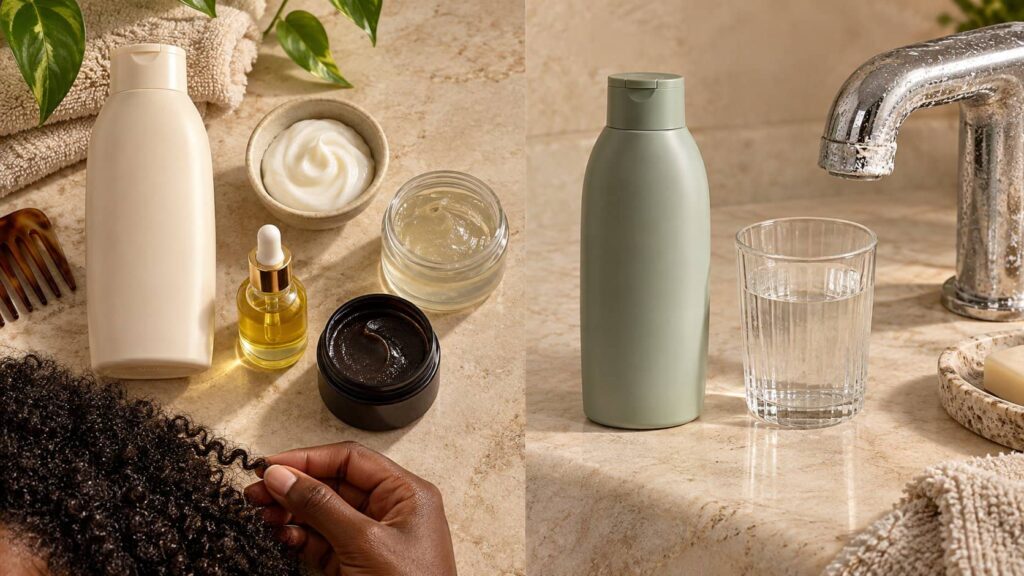
In the previous article, How Often to Use Clarifying Shampoo on 4C Hair After 50, I explained why clarifying has its own specific purpose.
Clarifying and chelating shampoos can overlap in what they do, but they are not the same thing.
A clarifying shampoo is primarily intended to give the hair a deeper cleanse and remove stubborn cosmetic residue.
A chelating shampoo contains ingredients that can bind metal ions and is particularly relevant when mineral deposits are the concern.
Some shampoos do both.
And this is important:
Chelating does not automatically mean stronger.
You can have an aggressive clarifying shampoo and a relatively gentle chelating formula.
The words describe what the shampoo is designed to help remove. They are not a ranking system from mild to strong.
That is why reading the product description, directions and complete formula matters.
For Tuesday’s post, the question was:
Does my hair need a deeper cleanse because of product buildup?
For this one, the question is:
Could minerals from my water be contributing to what I am feeling on my hair?
Two related questions.
Two different problems.
Why Mature 4C Hair Deserves a Thoughtful Approach
One reason I wanted to write this specifically for women over 50 is that the hair you have now may not behave the way it did twenty years ago.
Some women notice greater dryness with age.
Some notice reduced density.
Some find individual strands feel finer.
Grey strands may also feel or behave differently from pigmented hair.
And 4C itself only describes the curl pattern. It does not mean every woman with 4C hair has coarse strands.
You can have fine 4C hair.
You can have medium 4C hair.
You can have coarse 4C hair.
That is why I do not want to give every woman one aggressive cleansing rule simply because her curls are tight.
Mature textured hair often benefits from something much less dramatic.
Use the right cleanser for the right problem.
Then stop cleansing and return to conditioning and moisturizing.
How Often Should You Use Chelating Shampoo on 4C Hair?
There is no universal chelating schedule.
That may not be the answer people want, but it is the useful one.
How often you need chelation depends on factors such as:
- how hard your water actually is
- how often you wash your hair
- whether you swim regularly
- whether your hair is chemically treated or damaged
- how the specific shampoo is formulated
- how quickly you notice the same mineral-related problems returning
If you live with moderately hard water and your hair behaves normally, you may not need a dedicated chelating shampoo very often at all.
If your water is particularly hard and your hair repeatedly develops mineral buildup, you may find occasional chelation useful.
What I would not do is decide that every woman with 4C hair needs chelation every week, every two weeks or even every month.
The calendar cannot tell you what is sitting on your hair.
Your water exposure and your hair’s response matter more.
Start conservatively.
Follow the manufacturer’s instructions.
Then pay attention to what happens afterwards.
Did your hair feel more responsive?
Did conditioning work better?
Was there a noticeable difference?
Or did your hair simply feel drier?
That is useful information.
Can You Overuse Chelating Shampoo?
Yes, you can use any cleansing product more often than your own hair tolerates.
But I would not describe this dramatically as the chelating ingredients somehow eating away your 4C cuticle.
That is not a useful or accurate way to think about it.
The more practical problem is repeated deep cleansing.
If you repeatedly use a cleansing formula when there is little mineral buildup left to remove, you may end up washing hair more aggressively than necessary.
For hair that is already dry, fragile, colour-treated or prone to breakage, that can make the routine less comfortable.
Signs that your current frequency or formula may not suit you include hair that repeatedly feels unusually rough after washing, becomes much harder to detangle, feels excessively dry despite conditioning or appears to be breaking more during manipulation.
But again, do not assume chelating shampoo is responsible for every problem.
Persistent breakage, thinning, scalp pain, significant itching or hair loss deserves a broader look at your routine and, where appropriate, professional assessment.
How to Use Chelating Shampoo Without Drying Out 4C Hair
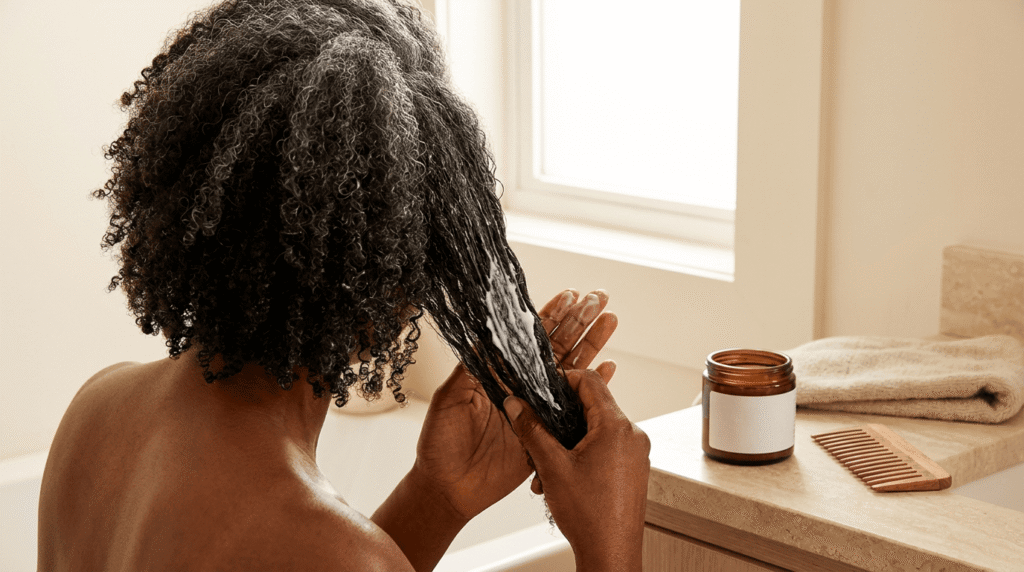
When you genuinely need chelation, I would keep the rest of the wash day uncomplicated.
Wet the hair thoroughly.
Use the product according to its directions rather than assuming leaving it on longer will make it work better.
Concentrate cleansing where you need it without aggressively rubbing or tangling the lengths.
Rinse thoroughly.
Then condition.
A good conditioner provides slip, helps soften the hair and makes detangling easier after cleansing.
If your hair tends to be very dry, you may prefer a richer conditioning treatment after chelating.
Detangle gently and work in sections where necessary.
Then return to the moisturising routine that normally works for your 4C hair.
You do not need to compensate for chelating shampoo by piling six oils and three butters onto your hair afterwards.
Clean.
Condition.
Moisturise.
Then see how your hair responds.
What Should You Look for in a Chelating Shampoo?
First, look for a product specifically designed for mineral, hard-water or metal buildup.
Then check the directions.
A product designed for frequent swimmer use may not have exactly the same directions as an occasional intensive mineral-removal treatment.
You may also encounter chelating ingredients such as EDTA and its salts, phytates or other compounds designed to interact with metal ions.
But again, I would not shop from the ingredient list alone.
Formulation matters.
Concentration matters.
The cleansing system matters.
And the fact that a shampoo contains disodium EDTA does not automatically tell you how effective the finished product will be at removing mineral buildup from your particular hair.
This is one reason the Chelating Agents entry in the Ingredient Glossary is useful.
Ingredients tell us part of the story.
The finished formula tells us the rest.
What If Hard Water Keeps Coming Back?
A chelating shampoo removes buildup that is already on the hair.
It does not change the water coming from your shower.
If you live with genuinely hard water, the minerals will continue being present every time you wash.
That does not mean you should respond by chelating constantly.
Instead, think about reducing unnecessary buildup while keeping the hair properly conditioned.
Depending on your water supply and home, you may also investigate water-softening options.
Be careful with claims around ordinary shower filters. A filter designed mainly to remove chlorine or sediment is not automatically a true water softener that removes calcium and magnesium hardness.
Know what problem you are trying to solve before paying for the solution.
Frequently Asked Questions
What is chelating shampoo?
Chelating shampoo contains ingredients that can bind certain mineral and metal ions so they can be removed more effectively during washing. It is particularly useful when mineral buildup from hard water or swimming is the concern.
Is chelating shampoo the same as clarifying shampoo?
Not exactly. Clarifying shampoo is primarily designed for deeper removal of cosmetic residue and styling-product buildup. Chelating shampoo specifically incorporates ingredients that bind mineral or metal ions. Some shampoos are formulated to perform both jobs.
What is the best chelating shampoo for hard water?
The best option is one specifically formulated for mineral or hard-water buildup that suits your own hair and scalp. Look beyond one ingredient and consider the entire formula, directions and how frequently the manufacturer recommends using it.
How often should I use chelating shampoo on 4C hair?
There is no universal schedule. Frequency depends on your water hardness, washing habits, product formulation and how your hair responds. Use it when mineral buildup is genuinely a concern rather than automatically putting chelation on a weekly calendar.
Can chelating shampoo dry out natural hair?
Some chelating shampoos can leave dry or fragile hair feeling rougher, particularly if they are cleansing formulas used more often than necessary. Conditioning afterwards and adjusting frequency according to your hair’s response are important.
Does hard water damage 4C hair?
Hard-water minerals can accumulate on hair and may affect properties such as feel or stiffness, but research on direct structural damage is mixed. Hard water should not automatically be blamed for every case of dryness, breakage or hair loss.
How do I know whether I need clarifying or chelating shampoo?
Think about what you are trying to remove. If styling products, oils and creams are the main issue, clarifying may be appropriate. If the concern is mineral buildup from hard water, a chelating formula may be more useful.
Does a shower filter fix hard water?
Not necessarily. Many shower filters are designed to reduce chlorine, sediment or certain contaminants. True water softening specifically addresses minerals such as calcium and magnesium. Check what the device actually removes rather than assuming every shower filter softens water.
The Honest Takeaway
Chelating shampoo for hard water can be an excellent tool.
But that is what it is.
A tool.
Not another product that every Black woman with 4C hair needs to add permanently to wash day.
First identify the problem.
Is it styling-product buildup?
Is it genuine mineral buildup?
Is the hair simply dry?
Is it damaged?
Or is there something happening at the scalp that shampoo alone will never solve?
Once you know what you are dealing with, the answer becomes much clearer.
If hard-water minerals are accumulating on your hair, occasional chelation may help remove them and allow your normal routine to work more effectively again.
Then condition.
Moisturise.
And leave the deep cleanser alone until there is a reason to reach for it again.
That is the approach I prefer after years of working with textured hair.
Do not use a stronger solution simply because the problem feels frustrating. Use the right solution because you understand the problem.
For Black women over 50, that kind of clarity matters.And that is exactly what The Melanin Tone is here to provide.