Itchy scalp and menopause can creep up on you at night.
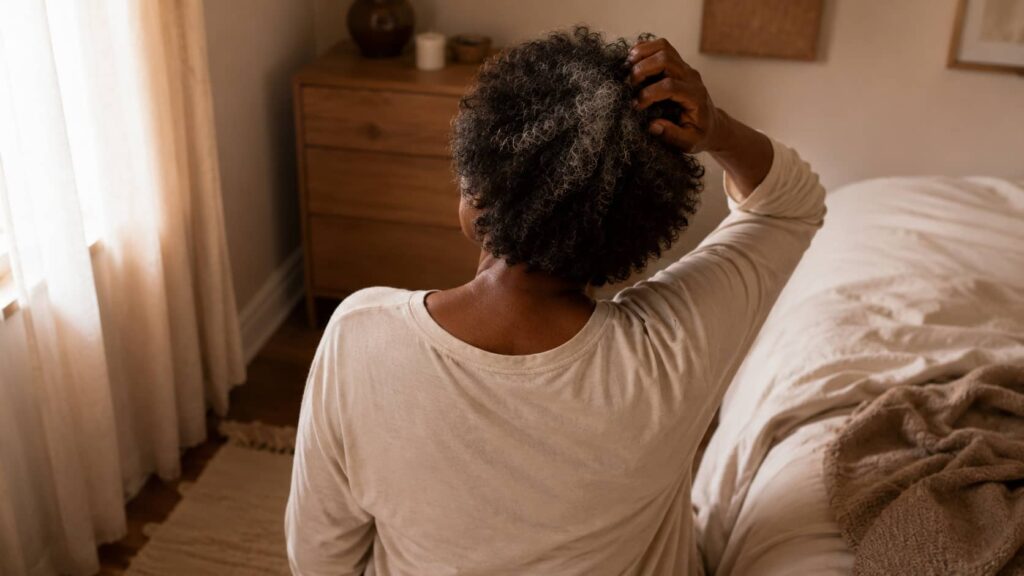
You are lying in bed, the house is quiet, and your scalp begins to prickle. Not a polite little tickle. A deep, insistent itch that seems to come from underneath the skin, somewhere you cannot quite reach. You scratch. It feels good for about four seconds. Then it moves somewhere else, and you scratch that spot too. Before you know it, you are sitting up in the dark, working your fingers along your hairline, wondering what on earth is happening to your head.
By morning you have convinced yourself it is the shampoo. Or the water. Or that new gel. So you change the shampoo, and nothing improves. You go back to the old one, and nothing improves. You buy the tea tree oil everybody swears by, and for two days you feel a little better, and then you are back to scratching in the dark.
I spent twenty two years with my hands in other womens hair, and I want to tell you something I wish I had said more clearly to my own clients. If you are somewhere in your late forties, your fifties, or beyond, and your scalp has suddenly turned on you, the problem is very often not your shampoo.
It may be your hormones.
Why Menopause Causes Dry Scalp
Here is the part nobody sits you down and explains.
Estrogen does a great deal of quiet work in your skin. It helps your skin hold water, supports oil production, and helps keep the barrier strong over time. When estrogen levels fall during perimenopause and menopause, all of that quiet work begins to weaken.
Most women know this shows up on the face. Your cheeks go tight. Your foundation catches on dry patches that were not there last year. Your skincare stops working the way it used to, and you cannot figure out why.
What almost nobody tells you is that your scalp is skin too.
It is the same skin, with the same barrier, the same oil glands, and the same dependence on hormones that are now declining. So while you are busy adding extra hydration to your face, your scalp may be quietly drying out under all that hair where you cannot see it. It produces less oil than it used to. It loses water faster than it used to. The barrier that kept it comfortable becomes thinner and more easily irritated.
And a dry, irritated scalp itches.
This is menopause dry scalp, and it is more common than most women realize. In my chair I watched it happen to woman after woman, all around the same age, all convinced they were the only one, all apologizing for scratching while I sectioned their hair.
You are not the only one.
And you are not imagining it.
Dry Scalp and Hair Loss, How They Are Connected
Now for the question that is really keeping you awake, because I know it is not only the itch.
It is the shedding.
You are itching, and you are also seeing more hair in the comb, more hair in the drain, more scalp showing at your part than you remember. And somewhere in the back of your mind a frightening thought has formed. Am I scratching my hair out.
Let me be careful and honest with you here, because this is where a lot of beauty writing goes wrong.
Scratching alone does not usually cause the kind of hair loss you are worried about. But chronic, aggressive scratching is not harmless either. When you scratch the same area night after night, you inflame the skin, you can damage the hair shaft, and over time you can break hair off close to the root. That is real, and it is worth stopping.
The bigger picture is this. Dry scalp and hair loss are often travelling together during menopause, not because one is causing the other, but because the same hormonal shift may be driving both at the same time. The scalp becomes drier and more fragile, and the hair may also become thinner, finer, and easier to shed.
So the itch is not stealing your hair.
But it may be a signal from the same source about the same season of change.
This matters for what you do next. If you believe the itch is causing the loss, you will pour all your effort into the itch and be baffled when the shedding continues. Treat the itch, yes. But understand the shedding on its own terms.
If you are trying to work out whether you are dealing with menopause shedding, traction alopecia, or something more serious, read Edges Thinning? A Salon Owners Honest Take on Why It Happens, And What Actually Helps.
What Scalp Irritation Actually Feels Like
Scalp irritation does not always announce itself as an itch.
I want to name the whole range, because women dismiss their own symptoms constantly, and the ones who tell me nothing is wrong are often the ones whose scalps are the most unhappy.
It can feel like tightness, the sensation that your scalp is a size too small for your head. It can feel like burning, a warm sting that flares when you sweat or when you take your hair down. It can feel like tenderness, so that brushing hurts and a tight style becomes unbearable after an hour. It can feel like tingling, or crawling, or a strange sensitivity where even the wind on your part feels wrong.
And yes, it can feel like an itch that no amount of scratching satisfies.
You may also see flaking, and this is where a lot of women get confused.
Dry Scalp or Dandruff, How to Tell the Difference
Flakes make everybody think dandruff, and the next move is usually a medicated shampoo.
But dry scalp flakes and dandruff flakes are not the same thing.
Dandruff flakes tend to be larger, oilier, and more yellowish. They usually come with a scalp that is not especially dry. Dry scalp flakes are often small, fine, white, and paired with a scalp that feels tight, parched, and uncomfortable.
Treating a dry scalp with an aggressive anti dandruff shampoo is one of the most common mistakes I saw. You strip an already stripped scalp, it dries out further, and the flaking gets worse. Then you use the shampoo more often because it seems to be getting worse, and you make it worse still.
If this is you, stop for a moment.
You may not be fighting dandruff at all.
You may be fighting dryness.
Why Dry Scalp on Black Hair Looks Different
Now here is the part almost nobody writes about, and the reason I think this conversation matters so much.
Most articles on scalp irritation were written for people whose scalp turns red when it is inflamed.
Ours often does not.
On deeper skin tones, inflammation may not present as obvious redness. It can show up as darkening, ashiness, a dusky patch, or a tone change that is easy to miss if you are looking for pink. So when you part your hair and search for the classic warning sign you have read about, you may not find it, and you conclude that nothing is wrong. Meanwhile, the scalp inflammation is very much there.
This is not a small oversight. It means our symptoms get missed, minimised, and sometimes dismissed outright.
Then there is the second layer. Dry scalp black hair care runs straight into our styling traditions, and I say this with love because these are my traditions too. Coily and textured hair is naturally drier than straight hair because the oils have a harder time travelling down the strand. So we compensate. We grease. We oil. We wear protective styles for weeks at a time.
Each of those choices makes sense on its own. But together, on a menopausal scalp that is already struggling, they can quietly become part of the problem. Product builds up. The scalp gets coated instead of comforted. The skin needs cleaning and support, but it gets more weight instead.
I am not telling you to abandon what you know.
I am telling you that a scalp at fifty five does not behave the way a scalp at twenty five did.
What a Healthy Scalp Should Look Like
Most women have genuinely never looked closely at their scalp.
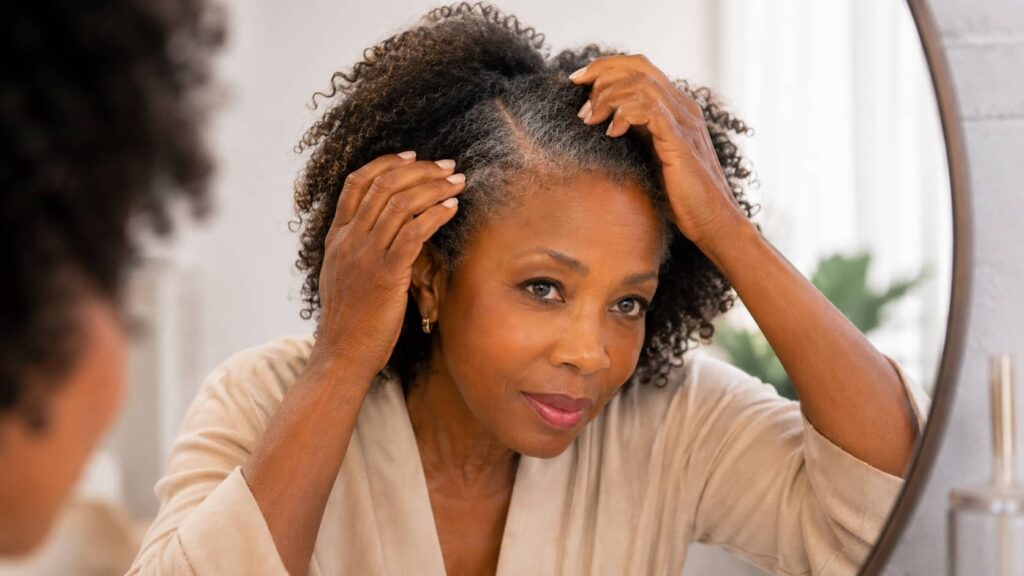
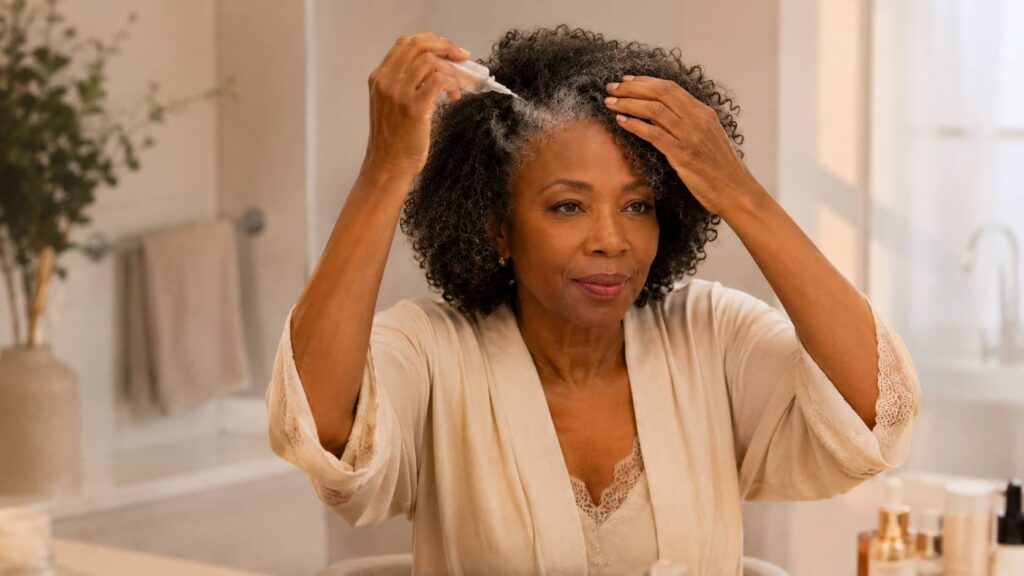
So do this in good light. Use a mirror and part the hair in several places. Look at the actual skin.
A healthy scalp looks like healthy skin anywhere else on the body. It is even in colour, matching the surrounding skin tone, without patches that are noticeably darker, ashier, or lighter. It is smooth, without raised bumps, crusting, or obvious scaling. It is clean, without a visible film of product sitting on top. It has hair growing from it at a normal density, without unexpected patches where the scalp suddenly shows through.
And most importantly, a healthy scalp does not keep asking for your attention. It should not itch, burn, sting, or feel tight. If you can feel your scalp all the time, something is asking for help.
Things that deserve a closer look include patches that are darker or ashier than the surrounding skin, shininess where hair used to grow, tenderness after taking your hair down, small bumps around follicles, and any area where the scalp is more visible than it was a year ago.
Take a photo in the same light every month.
Your memory lies.
Photographs do not.
Building a Scalp Care Routine That Holds
Here is what I would actually do, in order.
Wash more often than you think, and more gently than you think.
This is the step that gets the most resistance, and I understand why. We have been taught that washing dries the hair out. But an unwashed menopausal scalp is not being protected. It is being smothered under product, oil, and dead skin that can make the irritation worse.
For most textured hair, washing every seven to ten days with a gentle sulphate free shampoo is a reasonable place to begin. Focus on the scalp, not the lengths. Use lukewarm water, not hot.
Feed the scalp, not only the hair.
Look for humectants and barrier support instead of heavy grease. Glycerin, hyaluronic acid, ceramides, niacinamide, and squalane can all help support a drier scalp far better than another thick coating that just sits there.
A lightweight scalp serum on a clean scalp, worked in gently with the pads of your fingers, can do much more than another layer of grease.
Retire the heavy grease from the scalp itself.
Use your oils and butters on the lengths where they genuinely help. Give the scalp something lighter that can actually absorb.
Loosen everything.
Every style should be looser than feels natural to you. If it pulls, aches, or makes your temples feel tight, it is too tight. A scalp already under hormonal stress does not need mechanical stress as well.
Stop scratching, and give yourself something else to do.
Keep a cool soothing spray by the bed. When the itch starts, spray and press instead of scratching. Pressing relieves the sensation without tearing at the skin.
Give it three months.
This is not a three day fix. A scalp barrier that has been weakening over time will not rebuild in a fortnight. Most women I saw noticed meaningful change somewhere between six and twelve weeks.
When to Stop Treating It Yourself
I am a stylist, not a doctor, and there is a line I will not cross with you.
See a dermatologist, ideally one with experience of textured hair, if you have hair loss with any scarring, shininess, or smoothness where follicles seem to have disappeared. Go if you have pustules, sores, bleeding, or crusting. Go if the itch is severe enough to keep you awake often. Go if there is pain rather than itch. Go if you are losing hair in a defined pattern instead of all over. And go if you have followed a good routine faithfully for three months and nothing has moved.
Do not spend two years and a small fortune on serums for something that needed a prescription in month one.
The Honest Truth
I will not tell you that one scalp serum fixes menopause.
What I will tell you, after twenty two years with my hands in other womens hair, is this. The itch that arrives in your fifties is not a mystery, it is not your imagination, and it is not a personal failing. It is skin responding to hormonal change in the one place nobody ever thought to explain because it was hidden under your hair.
You cannot stop the change.
But you can stop treating a dry scalp like a dirty one.
You can stop stripping it, smothering it, and pulling it tight.
You can start looking at it, feeding it, and giving it room.
And you can stop apologising for scratching.
You were never the problem.
Nobody just told you what was happening.
That is what The Melanin Tone is for.