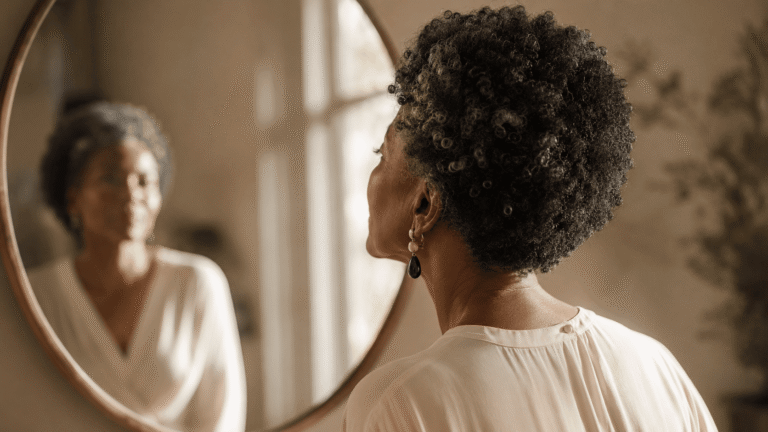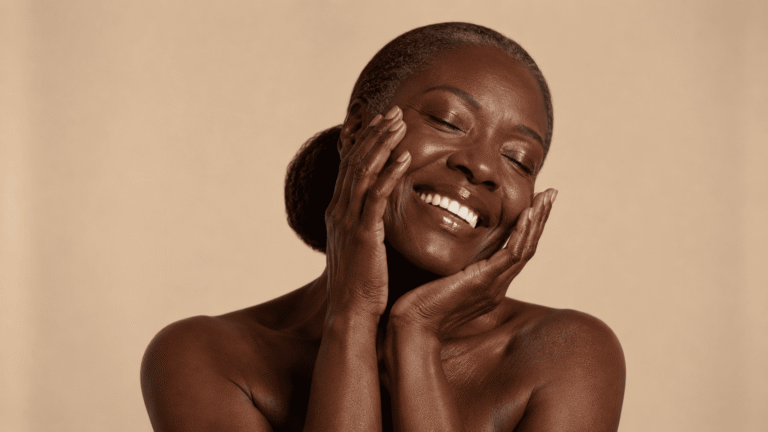
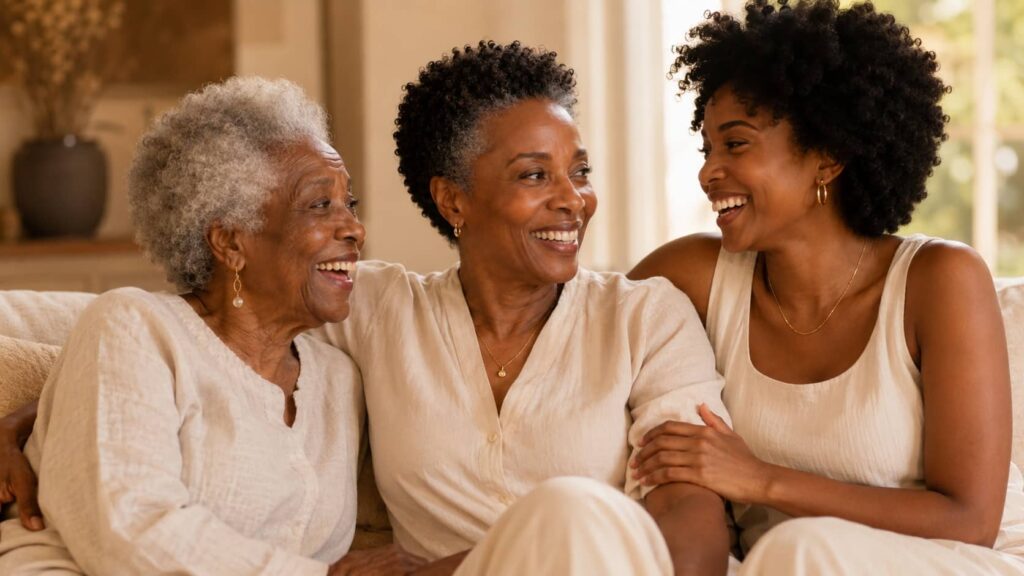
If you have ever wondered about the black dont crack meaning and what the phrase actually says about how Black skin ages, this post is for you. You have heard it your whole life. You have said it. You have laughed when older Black women in church and on the porch and at the salon repeated it like a blessing and a brag at the same time. Black don’t crack. The skin that holds the heat of a long life and refuses to show it. The face at sixty that could pass for forty. The aunt at seventy five who still gets carded.
For generations, that phrase has been a kind of love song to Black women’s faces. A small celebration in a world that did not always celebrate us. A bit of cultural medicine against the wider story that beauty fades and women disappear as they age. Black don’t crack felt like proof that we were exempt, that something protective ran through our melanin and our genes and our spirit that kept us looking younger longer than anyone else.
There is truth in it. There is also a softer truth underneath it, one that almost nobody named out loud until a generation of Black women turned fifty and started realizing the slogan had not prepared them for what midlife actually looks like on Black skin. I was one of those women. After 22 years behind a salon chair watching Black women age in real time, I want to talk honestly about where this phrase came from, what it really means, what part of it is true, and what part has cost us. Then I want to talk about what we do with the truth from here.
Pull up a chair.
Black Dont Crack Origin: Where the Phrase Comes From
The exact black dont crack origin is hard to pin to a single moment, which is the way oral culture usually works. The phrase did not start with a magazine cover or a celebrity. It started in Black families and Black neighborhoods, passed mother to daughter, aunt to niece, beautician to client, for as long as anyone can remember.
By the early two thousands the phrase had moved into mainstream popular culture.
It appeared in stand up comedy. It became the title of magazine articles about long lived Black celebrities. It appeared on T shirts and mugs. It crossed over into wider social media culture, sometimes used by Black women, sometimes appropriated by people who had nothing to do with the community that built it.
The deeper roots are older. Black women have been complimenting each other’s faces and skin for centuries, in churches and kitchens and beauty parlors. The phrase is part of a longer tradition of celebrating ourselves in spaces where the wider world did not. Black is beautiful in the 1960s gave us permission to say it loudly.
Black dont crack in later decades gave us permission to say it about our skin specifically. Both were acts of self love in cultural conditions that did not always reward self love.
When we trace the black dont crack origin, we are tracing a quiet, generational practice of refusing to hand over the authority to define beauty to anyone outside the Black community. The phrase carries that weight. When you say it, you are not just talking about a face.
You are participating in a small act of cultural resistance that has been passed down through generations of women who insisted on naming themselves beautiful before anyone else got the chance to. That is the part of the phrase worth honoring.
The next question is who is allowed to say it.
Is the Phrase Black Dont Crack Offensive
The question is the phrase black dont crack offensive comes up more often now, and the honest answer is that it depends on who is saying it and who they are saying it to.
Within Black communities, the phrase is in family language.
It is not offensive when Black women say it about each other. It is celebration, humor, sometimes a little vanity, sometimes a real acknowledgment of how exhausting the world has been and how miraculous it is that any of us still look as we do. Used within community, black dont crack is heritage, not harm.
When the phrase is used by people outside the Black community, the context changes. It can carry a flattening tone, as if Black women are a category of skin rather than a category of women. It can come close to fetishization, as if our faces are interesting only when measured against white aging timelines.
Some Black women have pushed back on the phrase when it shows up in white owned beauty content, mainstream media, or product marketing, because in those settings it can feel like our complexity is being reduced to a slogan that benefits someone else’s brand strategy.
So the phrase is not inherently offensive. It is contextual. Inside the community, it is family language. Outside the community, it requires care.
There is also a third concern that has emerged more recently, and this one matters most for this post. The phrase, even when said with love by Black women about Black women, has unintentionally created a kind of cultural blindfold. By telling generations of Black women that we do not crack, we have left ourselves unprepared for the moment when our skin does, in fact, begin to change.
That blindfold has cost women time, money, and skin health. To talk about it, we have to look at what the slogan really means in the present moment, when so many of us are crossing fifty for the first time.
What Does Black Dont Crack Mean for Black Skin Today
The question what does black dont crack mean sounds like it should have a simple answer, and the surface answer is straightforward. The phrase is a saying within Black communities that suggests Black skin shows fewer signs of visible aging compared to lighter skin. The face stays smoother. The wrinkles arrive later. The years sit lighter.
A woman in her fifties or sixties can look noticeably younger than a white woman the same age, and the slogan is the shorthand for that observation.
It is said with pride. It is said with humor. It is said to teenagers admiring their grandmothers. It is said in salons when a client refuses to share her real age. It is said in beauty editorials and on social media and in family group texts when someone posts a photo of her mother who looks impossibly fresh.
But underneath the lightness, the meaning has shifted in recent years as a generation of Black women has aged into a new conversation. Black dont crack meaning, today, has to include both halves of the truth. The pride and the reality. The celebration and the care.
The slogan held only the pride. The fuller meaning has to hold both.
A Black woman over 50 today is asking different questions than her mother was asking at the same age. She is reading dermatology research. She is following Black estheticians on Instagram. She is comparing notes with her friends about perimenopause symptoms. She is the first generation with real access to the science of how her skin actually works, and she is realizing that the slogan she grew up with was the headline, not the article.
The real meaning of black dont crack now is not that we do not age. It is that we age in our own way, on our own timeline, and that the care our skin needs in midlife is different from the care that mainstream beauty has ever centered. The phrase is not wrong. It is just no longer the whole story.
What Is Actually True About Black Skin and Aging
Here is where I want you to read slowly, because this is the section that matters most.
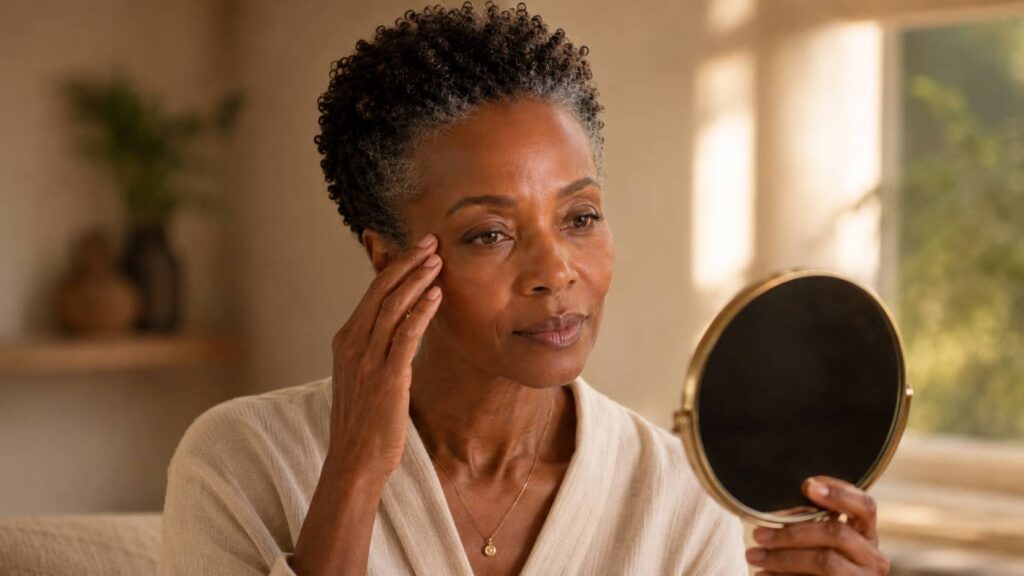
Black skin does age more slowly in visible ways than white skin. That is the kernel of biological truth inside the phrase, and it is worth naming clearly. The melanin in our skin offers some protection against UV rays, which are the single largest external cause of visible aging. Our skin tends to have a thicker, more compact outer layer that resists fine line formation. Our skin has more oil activity in younger years, which keeps it naturally moisturized. We tend to develop wrinkles later, less deeply, and in different facial zones than lighter skin.
All of that is real. None of it is in dispute. But here is what the slogan never said out loud.
Black skin still ages. The internal processes of aging happen on the same timeline as everyone else’s. Collagen production slows after thirty. Estrogen drops in our forties and fifties. Cell turnover decreases. The structural proteins that give skin its bounce break down. The fat pads in the face shift downward. Bone loss in the face changes the underlying structure. All of this happens to us on the same schedule it happens to every human body.
The difference is that on Black skin, these changes show up differently. Instead of fine lines we may see hyperpigmentation, melasma, and uneven tone. Instead of wrinkles in our twenties we may see them in our late fifties or sixties. Instead of sun damage that turns leathery, we may see sun damage that turns dark and stubborn. The aging is not absent. It is translated into our skin’s own language.
There is also one place where Black skin actually struggles more, not less, in midlife. Hyperpigmentation becomes harder to treat. Melasma flares for the first time in perimenopause. Dark spots from old breakouts linger for months instead of weeks. The skin barrier becomes more sensitive and more reactive to actives.
Menopause arrives for Black women on average a year earlier than for white women and often with more severe symptoms. These changes are real, they are biological, and they are not what the slogan prepared us for. The phrase gave us pride. It did not give us a manual. And too many of us turned fifty without one.
What Black Dont Crack Has Cost Black Women Over 50
A phrase is not just a phrase. The stories we tell ourselves shape what we believe is possible and what we believe we need to do. The cultural belief that Black skin does not need the same care as other skin has cost us in three specific ways.
It has cost us in sunscreen. For decades, Black women have been told that our melanin is built in sun protection. The truth is that melanin offers partial protection, somewhere between SPF 3 and SPF 13, which is far below the SPF 30 dermatologists recommend. We have skipped sunscreen for generations and paid in dark spots, melasma, premature collagen loss, and a higher rate of late stage skin cancer diagnoses than is widely recognized.
It has cost us in skincare investment. The belief that we do not crack has translated into a cultural pattern where Black women’s skincare budgets and routines have historically been smaller and simpler than they could have been. We have used what our mothers used. We have skipped the dermatologist visits. We have not pursued the ingredients and treatments that could have supported our skin through midlife. Not all of this is because of the slogan. Some of it is because the beauty industry has failed to make products that work for our skin. But the slogan has contributed.
It has cost us in medical attention. Black women’s symptoms in perimenopause and menopause are often dismissed by doctors who do not see us as patients who need this care. The cultural backdrop, partly fed by the black dont crack narrative, contributes to the assumption that we do not need the same medical conversation about hormonal aging that white women receive. The result is that we are often the last to receive hormone replacement therapy when it might help, the last to be diagnosed with skin conditions like CCCA or melasma, and the last to be taken seriously when we describe what is happening to our bodies.
This is not a small list.
The slogan that was meant to celebrate us has also, quietly, deprioritized us.
Where to Go From Here
The honest move at this point is not to retire the phrase. Black dont crack is heritage. It is community love language. It is a saying that grandmothers will continue to repeat at family gatherings for generations, and that is a beautiful thing.
The move is to add a second sentence to the slogan. Black don’t crack, and Black skin still changes, and Black skin still deserves care. Both can be true. The pride is not in conflict with the care. The celebration of how we age does not erase the responsibility to age with the right support.
For a Black woman over 50 reading this, the practical version of that second sentence looks like a few specific commitments. It looks like daily sunscreen, even on the days you cannot see the sun. Especially then. The hyperpigmentation you are trying to manage will not fade until you address the UV exposure that keeps deepening it.
It looks like a real skincare routine built around your skin’s actual needs, not the routine you inherited from your mother.
Hyaluronic acid for the dryness that arrived with perimenopause. Niacinamide for the dark marks that linger. Encapsulated retinol introduced gently for the texture you want to support. Peptides for the collagen you are slowly losing. Ceramides for the barrier that is now more reactive than it used to be.
It looks like finding a dermatologist who knows Black skin, before you think you need one. A derm who can spot CCCA in your scalp before it scars. A derm who can treat your melasma with the right combination of actives. A derm who can talk to you about hormone replacement therapy without dismissing your symptoms. This is not a luxury. It is an investment in the next thirty years of your face.
It looks like dropping the cultural pressure to age invisibly.
The most beautiful Black women I have seen in their fifties and sixties are not the ones pretending nothing is changing. They are the ones who know exactly what is changing, who are paying attention, and who are choosing what to do about it from a place of information rather than denial.
The slogan was a gift. The next chapter is a manual.
The Honest Truth About Aging in Black Skin
One last thing, because every post on this site ends with the truth. Black skin is genuinely beautiful at every age, and the slogan captured something real that deserves to be passed down. We do age more slowly in some ways. Our melanin does protect. Our families have produced generations of women who walked into rooms at sixty and stopped time.
But the slogan was never the whole story. It was the headline. The full article is the one we are writing now, together, in real time, as the first generation of Black women with access to honest information about menopause, mature skin, and what our bodies actually do after fifty.
If you grew up believing you would not crack and now you are looking in the mirror wondering why your skin feels different, your hair feels different, your face feels different, you have not been betrayed by your body. You have been failed by a slogan that was only ever half the truth. The other half is yours to claim now. The skin that has carried you for five decades deserves the care, the science, the dermatologist visits, the sunscreen, the gentle actives, and the honest attention it never asked for and never got.
You are not breaking. You are evolving. The mirror is not lying. The slogan was just too small to hold what we are. Welcome to the second half. The skin you have now is still beautiful. It is also asking for something specific. The good news is that you finally have the information to give it.