Why melanin rich skin deserves to be understood, protected and celebrated
Melanated skin is a term I kept seeing bring women to my blog, so I decided it was time to explain it properly.
When I looked at what people were searching for, I noticed something familiar. There were plenty of clinical definitions and plenty of beauty brands using the word melanin, but not much that spoke warmly and clearly to the women actually living in this skin.
That is exactly why The Melanin Tone exists.
To make the science understandable.
To separate fact from beauty marketing.
And, most importantly, to help Black women understand the skin they were born in without treating it as something that needs to be corrected.
So what does melanated skin actually mean?
What does melanin do?
Why do our skin tones vary so beautifully?
And why can the very pigment that gives Black skin much of its natural protection also make dark marks one of our most persistent skincare concerns?
Let us start there.
Summary
Melanated skin is an informal term commonly used for brown and Black skin rich in melanin. Melanin contributes to skin colour and provides some natural protection from ultraviolet radiation, but it does not replace sunscreen. Darker skin can also be more prone to noticeable post inflammatory hyperpigmentation, which is why gentle care, sun protection and avoiding unnecessary irritation are especially important. After 50, changes in dryness, firmness and pigmentation may also mean adjusting the skincare routine to suit mature melanin rich skin.
What Does Melanated Skin Mean?
The meaning of melanated skin is actually quite simple.
It generally refers to skin that contains a higher amount of melanin, particularly the brown to black pigment known as eumelanin.
Melanin is the natural pigment responsible for much of the colour we see in our skin, hair and eyes.
Everyone has melanin.
Black people do not have a completely different pigment system from everybody else, and darker skin does not simply mean having vastly more pigment producing cells.
People across skin tones have broadly similar numbers of melanocytes, the specialised cells that produce melanin. Much of the difference in visible skin colour comes from the type of melanin produced, the size and distribution of pigment containing structures called melanosomes, and how that pigment is processed within the skin.
So when we use the expression melanated skin, we are usually talking about brown and Black skin with substantial visible pigmentation.
It is worth knowing that melanated skin is not a formal medical diagnosis or scientific skin type.
It is a cultural and descriptive term.
And that matters.
For many Black people, the word has become a way of speaking about deeper skin with pride rather than treating dark skin as a deviation from something else.
The Science of Melanated Skin
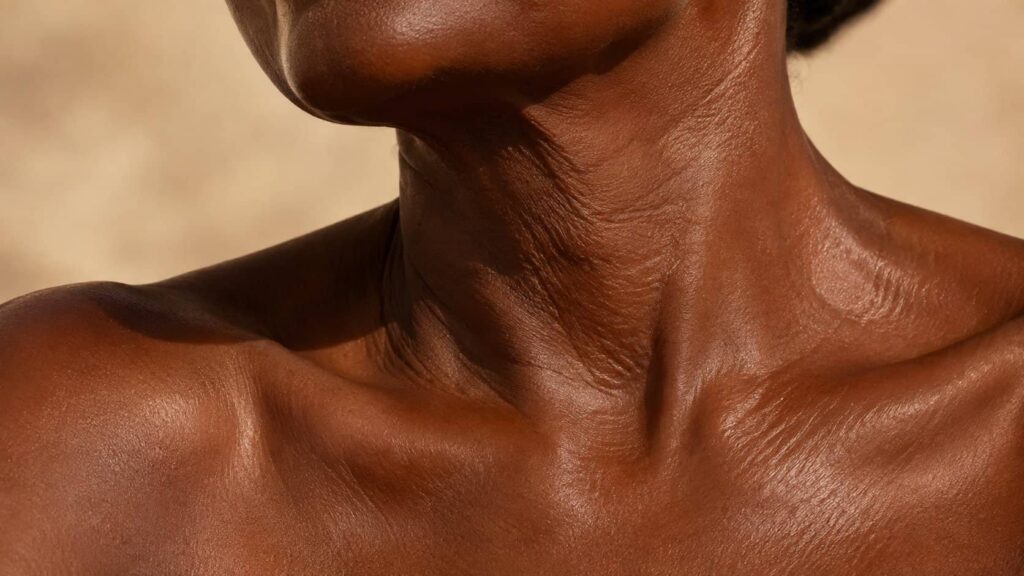
Melanin is much more than colour.
One of its important functions is helping the skin respond to ultraviolet radiation from the sun.
What Melanin Actually Does
Melanin can absorb and disperse some ultraviolet radiation before that radiation causes damage deeper within the skin.
Eumelanin, which is brown to black, is particularly effective at absorbing ultraviolet radiation.
Pheomelanin is the yellow to reddish pigment found in varying amounts in human pigmentation.
Darker skin generally contains more eumelanin and has melanosomes that tend to be larger and more widely distributed through the epidermis.
That contributes to the natural photoprotection associated with deeply pigmented skin.
But this is where we need to be careful with the word protection.
Melanin provides some natural protection.
It does not create an invisible sunscreen.
Black skin can still experience ultraviolet damage, premature ageing, pigmentation changes and skin cancer.
Understanding melanin should make us appreciate what it does without expecting it to do everything.
Why Human Skin Colour Varies Around the World
This is one of the most fascinating parts of the story.
Human skin pigmentation evolved in close relationship with ultraviolet radiation.
For populations whose ancestors lived for many generations in areas with intense ultraviolet exposure, particularly tropical regions, darker eumelanin rich pigmentation offered important photoprotection.
As human populations moved into regions with lower and more seasonal ultraviolet exposure, different pigmentation patterns evolved.
One explanation researchers have studied involves balancing two biological pressures.
High ultraviolet exposure can damage folate, while ultraviolet B exposure is also involved in vitamin D production in the skin.
Over many generations, geography, ultraviolet exposure, genetics, migration, diet and natural selection all contributed to the extraordinary range of human skin tones we see today.
It is therefore too simple to say that skin colour is determined only by how close somebody’s ancestors lived to the equator.
Human pigmentation is more complex than a single map.
But there is a clear evolutionary relationship between ultraviolet environment and human skin pigmentation.
I find that beautiful.
Skin colour is not a random cosmetic detail.
It carries part of the story of human adaptation.
Deep Melanin Rich Skin Is Not Something to Correct
For generations, darker skin has often been discussed through the language of correction.
Too dark.
Too uneven.
Too ashy.
Too difficult.
Too much melanin.
Even today, beauty marketing can quietly reinforce the idea that brighter must mean lighter.
I reject that completely.
Healthy Black skin does not need to become lighter to become beautiful.
And glow does not mean bleaching away your natural complexion.
Deep melanin rich skin can be luminous, even toned and healthy while remaining beautifully deep.
There is also enormous variation within Black skin.
Black women are not one shade.
We range across deep ebony, blue black, rich brown, chestnut, caramel and countless undertones and variations between them.
Even within the same family, skin tones can look completely different.
Melanin is not one colour.
It is a spectrum.
What Does “Melanated Queen” Mean?
You may also have heard the expression melanated queen.
This is not a scientific term either.
It is a cultural expression of pride and affection often used to celebrate Black women, particularly women with rich, deep skin.
I understand why language like this resonates.
For generations, darker skin was frequently positioned as something less desirable. Words that deliberately celebrate melanin turn that history around.
But I do not think a Black woman needs to perform pride every day either.
You do not have to wake up every morning feeling regal about your skin.
You simply deserve to live in it without believing that its natural depth needs to be apologised for.
That, to me, is the more important message.
Why Dark Spots Can Be So Persistent on Melanated Skin
Here is where understanding melanin becomes particularly useful for skincare.
The pigment producing system in darker skin can respond strongly to inflammation.
A spot.
A scratch.
Eczema.
A burn.
Friction.
An irritating skincare product.
Even an aggressive treatment intended to remove pigmentation can sometimes create more inflammation.
After that inflammation settles, the affected area may remain darker than the surrounding skin.
This is known as post inflammatory hyperpigmentation.
It can happen in any skin tone, but it is often more noticeable and can persist longer in darker skin.
This is one reason dark spots and hyperpigmentation are such important concerns for Black women.
And it explains something I saw repeatedly during my years in beauty.
Sometimes women attacked a dark mark because they wanted it gone quickly.
They scrubbed harder.
Used stronger acids.
Added another brightening treatment.
And the skin became more irritated.
With melanated skin, aggression can sometimes give you exactly the opposite of what you wanted.
The first goal should often be to calm whatever is creating the inflammation.
Then address the remaining pigmentation patiently.
Caring for Melanated Skin After 50
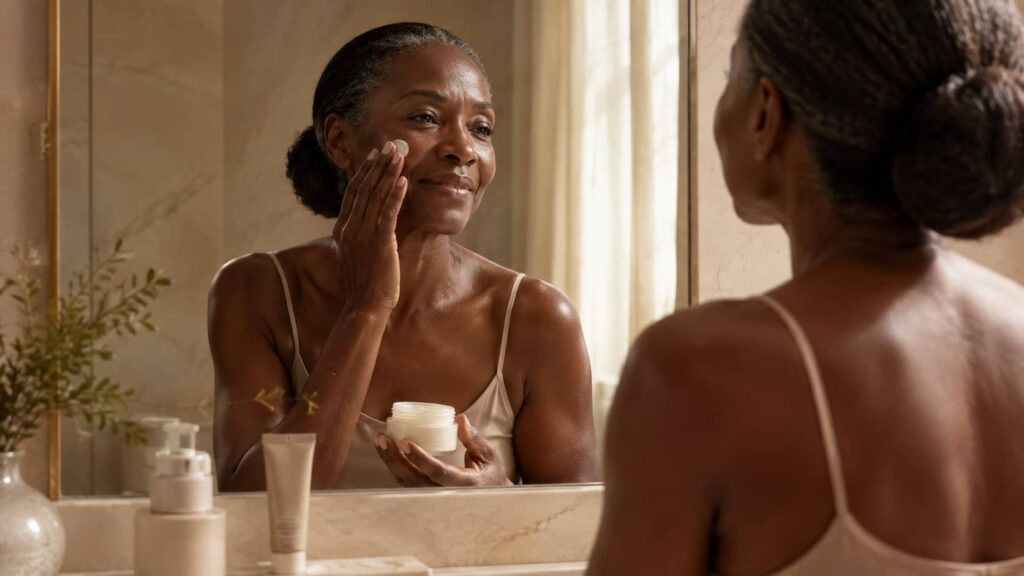
Melanated skin is not one skin type.
You can have deeply pigmented skin that is oily.
Dry.
Combination.
Sensitive.
Acne prone.
Or somewhere between several of those categories.
And after 50, another layer enters the picture.
Mature skin can change as hormones shift around menopause and as the skin naturally ages.
You may notice increasing dryness.
Your old cleanser may suddenly feel harsh.
You may find that products you tolerated for years now sting.
Skin can lose some of its firmness and elasticity.
Pigmentation may become more noticeable.
Your skincare routine should respond to the skin you have now rather than the skin you had at 30.
Cleanse Gently
Your face does not need to feel tight to be clean.
A gentle cleanser that removes daily buildup without leaving mature skin stripped is often enough.
Prioritise Hydration and Moisture
A hydrating serum can help when the skin feels dehydrated, while a moisturiser helps reduce moisture loss and support the skin barrier.
Ingredients such as glycerin, hyaluronic acid, ceramides and panthenol may be useful depending on the individual formula and your skin.
Be Careful With Irritation
More active ingredients do not automatically mean better results.
If you are already pigmentation prone, repeatedly irritating your skin can make managing uneven tone harder.
This is particularly important when experimenting with ingredients that may irritate sensitive or pigmentation prone skin.
Introduce active products gradually and pay attention to how your individual skin responds.
Treat Dullness Gently
If dull skin after menopause is making your complexion look tired or flat, do not assume the solution is aggressive exfoliation.
Sometimes dehydration is part of the problem.
If you do use an exfoliant, choose one your skin tolerates and avoid introducing several strong treatments at once.
Healthy glow should come from skin that is comfortable, hydrated and cared for.
Not from skin that has been scrubbed into submission.
Does Melanated Skin Need Sunscreen?
Yes.
This is one myth I would like us to leave behind.
Black skin has natural photoprotection from melanin, but that does not make sunscreen unnecessary.
A broad spectrum sunscreen with SPF 30 or higher helps protect against ultraviolet exposure.
Sun protection is also particularly relevant if hyperpigmentation is one of your concerns.
Ultraviolet light can darken existing pigmentation, and visible light from the sun can also contribute to hyperpigmentation in darker skin tones.
For women concerned about dark spots, a tinted sunscreen containing iron oxides may offer additional protection from visible light.
And there is another practical issue.
Nobody wants a sunscreen that leaves deep skin looking grey.
Fortunately, sunscreen formulas have improved enormously, and tinted or sheer formulas can make avoiding a visible white cast much easier.
The best sunscreen is one that gives appropriate protection, agrees with your skin and is pleasant enough that you will actually use it.
From the Salon Chair
During my 22 years in the salon, I watched many Black women have complicated relationships with their skin.
Some scrubbed at it.
Some tried to bleach marks away.
Some believed darker meant less beautiful.
And sometimes the products they were using were causing the very irritation and unevenness they were trying to remove.
I wish more of us had been taught the science earlier.
Not because understanding melanocytes and eumelanin suddenly solves every skincare problem.
But because knowledge changes the starting point.
You stop asking:
How do I fix this dark skin?
And begin asking:
What does my skin need?
Those are two very different questions.
One begins with rejection.
The other begins with understanding.
That is the kind of skincare I believe in.
Frequently Asked Questions About Melanated Skin
What is melanated skin?
Melanated skin is an informal term generally used to describe brown and Black skin that contains substantial melanin pigmentation. Melanin is the natural pigment that contributes to the colour of skin, hair and eyes.
Is melanated skin the same as Black skin?
The expressions are often used together, but melanated is broader and is not a medical racial classification. People across many populations have richly pigmented skin. In everyday cultural use, however, the term is commonly associated with Black and brown skin.
Does everyone have melanin?
Yes. People of all skin colours have melanin. Differences in skin tone involve the type, amount, distribution and processing of melanin rather than one group having melanin and another having none.
What does it mean to be highly melanated?
It generally means having more visible melanin pigmentation and a deeper natural skin tone. It is a descriptive expression rather than a clinical diagnosis.
Does melanated skin age differently?
Some visible signs of photoageing, particularly certain fine lines, may appear later in darker skin because melanin offers some natural protection from ultraviolet radiation.
That does not mean Black skin does not age.
Dryness, uneven pigmentation, changes in texture, loss of firmness and other changes can all become more noticeable with time.
Why does melanated skin get dark marks?
Inflammation can stimulate pigment production. After acne, irritation, injury or another inflammatory problem settles, darker skin may be left with post inflammatory hyperpigmentation.
Preventing unnecessary irritation is therefore an important part of caring for pigmentation prone skin.
Does melanated skin need sunscreen?
Yes. Melanin provides some natural protection, but it is not complete sun protection. Broad spectrum sunscreen helps protect the skin from ultraviolet exposure and can also be particularly useful when managing hyperpigmentation.
The Honest Takeaway
So, what is melanated skin?
It is a cultural term for skin rich in the pigment that gives human complexion much of its extraordinary range.
It is biology.
It is adaptation.
And for many Black women, it is identity too.
But I do not want us to romanticise melanin so much that we stop understanding it accurately.
Melanin is protective, but it is not sunscreen.
Melanated skin can be resilient, but it can also be sensitive.
Deep skin can glow beautifully, but it can also develop stubborn pigmentation.
And Black skin is not one skin type.
Understanding those differences allows us to care for our skin more intelligently.
Your melanin is not something you need to scrub away, bleach away or apologise for.
Understand it.
Protect it.
Keep it moisturised.
Treat inflammation gently.
And when your skin changes with age, change the routine with it.
That is what The Melanin Tone is here to do.
To help Black women over 50 understand the skin they already have, and care for it from a place of knowledge rather than fear.