
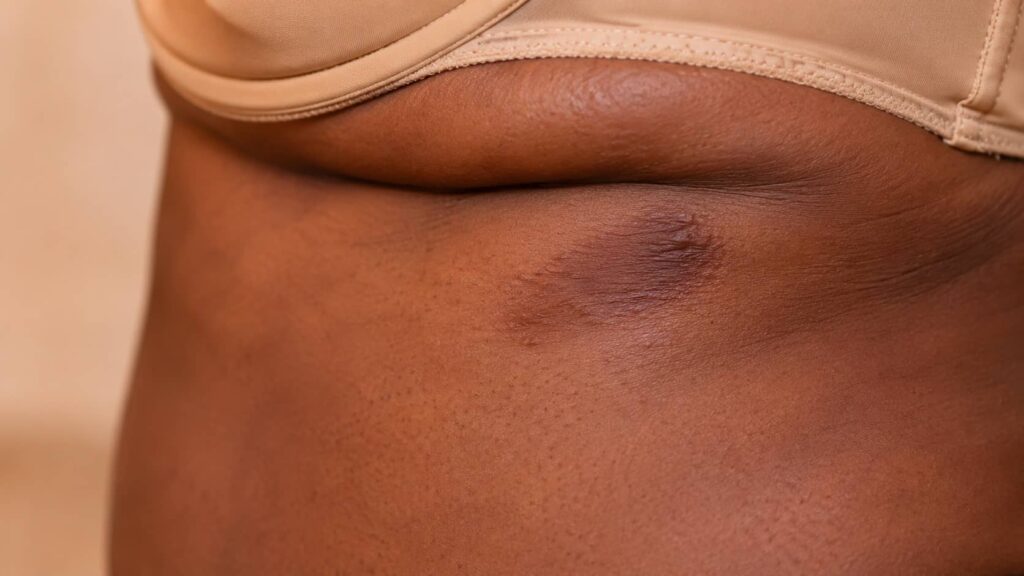
From bra lines and glasses to inner thighs and CPAP straps, the overlooked reason melanin rich skin darkens where it rubs.
Frictional hyperpigmentation is the darkening that can develop where skin is repeatedly rubbed, pressed, or irritated.
You may notice it along the line of a tight bra. On the bridge of your nose where your glasses sit. Across your cheeks from a CPAP mask. Around your waist beneath a firm waistband. Or between your thighs where the skin rubs as you walk.
The marks often appear quietly. There may be no dramatic rash and no obvious injury. You simply notice one day that the skin in that area has become darker.
I know this from my own body.
For a while, I wore a tight underwire bra that pressed and rubbed against both sides of my bust. The skin darkened in the exact places where the wire sat.
At first, it would have been easy to focus only on fading the marks. But the real problem was not a lack of brightening serum. It was the bra.
I stopped wearing it and changed to a softer, properly fitted padded bra that did not dig into my skin. Once the rubbing stopped, I used a niacinamide product gently and consistently. The marks gradually improved, and they did not return because I had removed the cause.
That experience taught me the most important lesson in this article.
You cannot fade a mark you are still rubbing every day.
First, find what is causing the friction.
Then let the skin recover.
Only after that should you begin treating the pigment.
What Is Frictional Hyperpigmentation?
Frictional hyperpigmentation is a practical term for darkening that develops after repeated rubbing, pressure, or mechanical irritation.
Some friction related pigment conditions are medically described as friction melanosis. The terminology can vary depending on where the mark appears and how the skin has changed, but repeated mechanical stress is the central trigger. Research on friction melanosis describes recurrent rubbing and pressure from clothing as recognised causes of brown pigmentation, particularly over areas that experience repeated contact.
Repeated friction does more than move across the surface of the skin. Over time, it can cause irritation, inflammation, scaling, thickening, cracking, or pigment changes. The exact reaction depends on the strength of the friction, how long it continues, the location, moisture levels, and the condition of the skin barrier.
When inflammation or injury triggers extra pigment production, the darkening left behind is called post inflammatory hyperpigmentation.
The dark mark is not dirt.
It is not proof of poor hygiene.
It is the visible result of skin responding to repeated stress.
Why Frictional Hyperpigmentation Can Be More Persistent on Black Skin
Post inflammatory hyperpigmentation can happen in any skin colour. However, it is generally more noticeable, more intense, and longer lasting in darker skin tones.
That is why the same pressure can leave different marks on different women.
One woman removes a tight bra or pair of glasses and sees temporary redness or a shallow dent.
Another woman develops a brown, grey brown, or almost black patch that remains long after the pressure has stopped.
This does not mean Black skin is weak.
Melanin rich skin is highly responsive. When irritation signals the skin to produce more pigment, the resulting colour can remain visible long after the original irritation has settled.
Sunlight can make exposed marks darker. Pigment that develops on the face, neck, chest, arms, or other uncovered areas may deepen further without sun protection.
Age may also change how comfortable your usual clothing and accessories feel. Skin that has become drier or more sensitive may tolerate tight straps, underwire, firm waistbands, or heavy frames less comfortably than it did before.
You may not have changed what you wear.
Butwire, firm waist your skin may no longer respond to it in the same way.
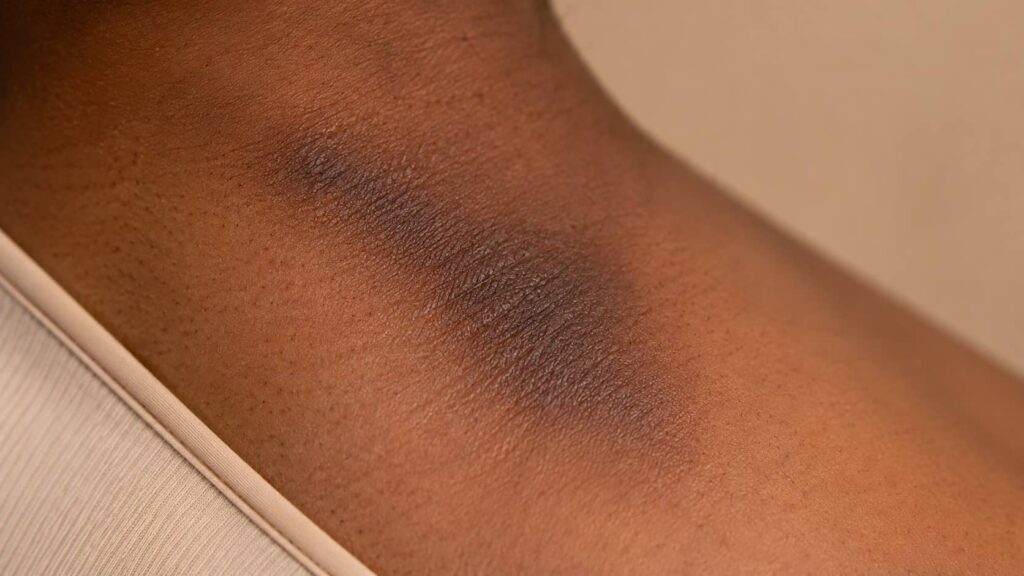
Where Repeated Friction Can Leave Dark Marks
Frictional hyperpigmentation tends to appear in places where pressure or rubbing happens repeatedly.
Beneath bras and bra straps
An underwire that digs into the same area every day can leave a curved line of irritation and pigment.
Straps that are too tight may also create marks across the shoulders. The problem is usually not the existence of the bra itself. It is concentrated pressure from a poor fit, rough material, or repeated movement.
On the nose and behind the ears
Glasses can create pressure and friction along the bridge of the nose, at the sides of the nose, near the temples, or behind the ears.
Some marks disappear after the frames are removed. Others remain as dark patches, particularly when the glasses are heavy, constantly sliding, or incorrectly fitted.
Across the face from CPAP equipment
A CPAP mask rests against the face for several hours every night. Pressure from the mask and straps, movement during sleep, moisture, and sensitivity to the material can all irritate the skin.
Because CPAP is medically necessary, the answer is not simply to stop using it. The fit, mask style, pressure points, cleaning routine, and possible need for liners should be discussed with the equipment provider or medical team.
Around the waist
Tight waistbands, shapewear, belts, and firm elastic can create a repeated line of pressure around the abdomen or hips.
The mark may become more noticeable where the waistband rolls, twists, or rubs during movement.
On the inner thighs
Skin rubbing against skin can create ongoing friction between the thighs. Heat, sweat, and close fitting clothing may add to the irritation.
This is common and says nothing about cleanliness or personal care.
In the armpits
The underarms deal with several possible sources of irritation, including skin friction, shaving, fragranced deodorant, tight sleeves, heat, and moisture.
Darkening here should not automatically be blamed on one cause.
Around the hairline
Headwraps, scarves, wigs, bands, and bonnets can create repeated pressure when tied tightly or placed in exactly the same position every day.
If the hairline is also thinning, sore, or developing bumps, the style may be creating more than pigment. It may also be placing unnecessary tension on the hair and scalp.
On elbows, knees and knuckles
Leaning repeatedly on the elbows, kneeling, or applying pressure to the hands can contribute to darkening and thickening in these areas.
However, not all naturally deeper colour on knees, elbows, and knuckles is abnormal or caused by friction. Natural variation in body pigmentation is common.
When Darkening May Not Be Caused by Friction
Not every dark area in a place that rubs is frictional hyperpigmentation.
The armpits, groin, inner thighs, neck, and area beneath the breasts are also affected by moisture, heat, shaving, product irritation, eczema, contact dermatitis, fungal infections, bacterial conditions, and other skin problems.
This distinction matters because a brightening serum will not treat an active rash or infection.
One condition that can be mistaken for ordinary friction marks is acanthosis nigricans. It usually causes thicker, brown, velvety skin, particularly around the neck, armpits, groin, and beneath the breasts. It is often associated with an underlying metabolic or hormonal condition, although it does not always mean the same thing for every person.
Speak with a doctor or dermatologist when the dark area:
- Feels thick or velvety
- Spreads beyond the area being rubbed
- Appears suddenly or changes quickly
- Is painful, itchy, scaly, cracked or weeping
- Develops an unusual smell
- Appears around the neck as well as the armpits or groin
- Does not improve after the suspected friction has stopped
You should also seek advice if you are uncertain about what you are seeing.
There is no benefit in spending months treating pigment when the skin is trying to tell you that something else is happening.
Frictional Hyperpigmentation Treatment for Black Skin
Treating frictional hyperpigmentation begins with the cause, not the colour.
That means the first step is not buying a stronger acid.
It is finding out what is rubbing.
Step 1: Remove or reduce the friction
Look closely at the exact shape and location of the mark.
A curved line beneath the breast may follow an underwire.
Two small patches on the nose may match the position of your glasses.
Darkening along the waist may follow the elastic of your underwear, trousers, or shapewear.
Marks on the cheeks may line up with a CPAP mask.
The shape often reveals the source.
Once you identify it, change what you can.
Have glasses professionally adjusted.
Replace a painful bra with a correctly fitted one.
Choose softer waistbands and breathable clothing.
Avoid tying headwraps too tightly.
Discuss CPAP pressure points with your equipment provider rather than simply tightening or loosening the mask yourself.
When skin rubs against skin, softer, breathable clothing may help reduce direct contact and trapped moisture.
Do not continue tolerating something that hurts because you believe beauty or support must be uncomfortable.
Persistent pressure is your skin asking for a change.
Step 2: Let irritated skin settle
If the area feels sore, itchy, raw, or sensitive, do not begin with brightening products.
Keep the routine simple.
Wash gently.
Pat the skin dry rather than rubbing it with a towel.
Use a plain, fragrance free moisturiser.
Avoid perfume, strong acids, scrubs, and several active ingredients layered together.
The aim at this stage is to calm the irritation and support the skin barrier.
When the skin no longer feels inflamed, you can consider addressing the remaining pigment.
Step 3: Choose one pigment care ingredient
Once the friction is controlled and the skin feels comfortable, one well tolerated pigment ingredient may help the dark mark gradually improve.
Options used for post inflammatory hyperpigmentation include:
- Azelaic acid
- Vitamin C
- Niacinamide
- Arbutin
- Kojic acid
- Certain retinoids
DermNet lists several of these among the topical options for post inflammatory hyperpigmentation. The American Academy of Dermatology also includes azelaic acid and vitamin C among ingredients that may help fade dark spots.
You do not need all of them.
Choose one.
Introduce it slowly and follow the product directions.
Stop using the product if it causes burning, stinging, peeling, or soreness. Irritation can cause new dark spots and make existing hyperpigmentation darker, especially on melanin rich skin.
I used niacinamide on my own bra marks, and it suited my skin.
That does not mean the same ingredient will be right for everyone. The most useful product is the one your skin can tolerate consistently without creating another cycle of irritation.
Step 4: Protect exposed marks from light
Sunscreen matters on marks that sunlight can reach.
This includes pigmentation on the face, nose, neck, chest, shoulders, arms, hands, knees, and feet.
AAD recommends broad spectrum SPF 30 or higher. For people prone to dark marks, tinted sunscreen containing iron oxide can provide additional protection from visible light.
Sunscreen is less relevant beneath a bra or clothing that completely covers the skin. Use it where the area is exposed rather than applying it automatically to every body mark.
Step 5: Give the skin time
Dark marks do not disappear as quickly as the irritation that caused them.
Once the cause has stopped, a spot only a few shades darker than your natural skin tone may take around 6 to 12 months to fade. Deeper grey, blue grey, or very dark pigmentation can take considerably longer, sometimes years.
That timeline is one reason people become impatient and begin scrubbing.
But force rarely makes pigment leave faster.
It usually creates another round of inflammation.
What Not to Use on Frictional Hyperpigmentation
Avoid treating the skin as though the pigment needs to be scrubbed off.
It does not.
Harsh scrubs, rough exfoliating gloves, loofahs, strong home peels, lemon juice, baking soda, toothpaste, and household bleach can irritate or injure the skin.
Liquid bleach should never be applied to the skin. The AAD also warns that some unregulated skin lightening products have been found to contain undeclared steroids or mercury.
Be careful with products sold as instant bleaching or whitening solutions.
The word “fast” is especially tempting when the mark has affected your confidence for years. But stronger is not always better for melanin rich skin.
An ingredient that creates burning, soreness, or peeling may leave you with more pigment than you had before.
How to Prevent Friction Marks From Returning
The goal is not only to fade an existing mark.
It is to stop recreating it.
Pay attention to discomfort early. Do not wait until the skin has darkened significantly before adjusting a bra, pair of glasses, strap, waistband, or head covering.
Check how clothing fits while sitting and moving, not only while standing in front of the mirror.
Choose materials that feel soft against the skin.
Keep areas that become sweaty clean and dry, but do not scrub them repeatedly.
Replace blunt razors and use a gentle shaving product if hair removal irritates your underarms or bikini line.
Moisturise dry areas regularly.
Change the position of headwraps, bands, and accessories rather than placing pressure on the same area every day.
And most importantly, notice patterns.
Your skin is often showing you exactly where the problem begins.
When to See a Dermatologist
See a dermatologist when the darkening remains unexplained or when the skin is uncomfortable.
Professional advice is particularly important when the area is raised, thick, velvety, itchy, painful, broken, spreading, or changing quickly.
You should also seek help when gentle care has not improved the mark, or when you are considering prescription creams, chemical peels, or laser treatment.
Procedures can sometimes help epidermal pigmentation, but they can also aggravate post inflammatory hyperpigmentation by injuring the skin. This risk makes professional experience with darker skin tones especially important.
Do not let anyone convince you that aggressive treatment is automatically more effective.
For Black skin, the skill of the practitioner and the control of inflammation matter as much as the treatment itself.
Frequently Asked Questions About Frictional Hyperpigmentation
What is frictional hyperpigmentation?
Frictional hyperpigmentation is darkening that develops after repeated rubbing, pressure, or irritation in one area. It may appear beneath tight clothing, along bra lines, on the nose from glasses, between the thighs, or where equipment such as a CPAP mask touches the skin.
Does frictional hyperpigmentation go away?
It can improve once the cause of the friction has been removed. Fading usually happens gradually rather than immediately. A mild mark may take several months to fade, while deeper pigmentation can remain visible for much longer, sometimes years.
How do you treat frictional hyperpigmentation on Black skin?
Begin by reducing the rubbing or pressure. Let irritated skin settle, use a gentle moisturiser, and introduce one pigment care ingredient only when the skin feels comfortable. Sunscreen is important on areas exposed to light.
Can niacinamide fade friction marks?
Niacinamide is one topical ingredient used for post inflammatory hyperpigmentation and may help some people. It should be introduced gently and stopped if it causes burning, stinging, redness, or irritation.
Why are my inner thighs darker than the rest of my body?
Friction between the thighs may contribute, but it is not the only possible cause. Moisture, shaving irritation, dermatitis, infection, natural pigmentation, and conditions such as acanthosis nigricans may also affect the area. Seek medical advice if the skin is thick, velvety, painful, itchy, rapidly changing, or spreading.
Are dark armpits always caused by friction?
No. Friction may contribute, but deodorant irritation, shaving, eczema, infection, and acanthosis nigricans are other possibilities. A dermatologist can help identify the cause when the darkening is persistent or accompanied by other skin changes.
Can a CPAP mask cause dark marks?
Repeated mask pressure, movement, moisture, or material sensitivity may cause irritation and leave pigmentation. Because CPAP treatment is important, speak with the equipment provider or medical team about fit, mask style, liners, or possible material sensitivity rather than stopping treatment.
Can glasses cause frictional hyperpigmentation?
Yes, repeated pressure and rubbing from poorly fitted or heavy frames may leave persistent dark marks on the nose or behind the ears. A professional frame adjustment should come before pigment treatment.
The Honest Takeaway
Frictional hyperpigmentation is one of those skin concerns many women live with without ever being given a proper explanation.
You see the dark line beneath your bra and wonder whether you failed to wash properly.
You see the mark on your nose and blame your skin.
You notice the colour between your thighs and feel embarrassed by something that is often part of living in a moving, changing body.
The mark is not dirt.
And it is not a personal failure.
It is a signal.
Something has been rubbing, pressing, or irritating the same area repeatedly.
Find the source.
Reduce the friction.
Let the skin settle.
Then treat the remaining pigment gently and give it time.
That was the answer for my own underwire marks. The product helped, but changing the bra was what made lasting improvement possible.
Your skin does not need punishment.
It needs you to listen to what it has been trying to tell you.
Find what rubs. Stop it. Let your skin recover.